Choosing between salary and dividends is one of the most important decisions for limited company directors and shareholders in 2026/27. While many directors take a combination of both, the right balance depends on your company’s profits, your personal tax position and how you want to withdraw income from the business.
The way you pay yourself affects your personal tax, National Insurance and your company’s Corporation Tax position.
As tax rates and thresholds continue to change, it is worth reviewing whether your current approach remains the most tax-efficient way to pay yourself.
Key takeaways
- For many limited company directors, a salary of £12,570 with dividends from remaining profits is a common approach, though the right salary can vary depending on your Employment Allowance position
- Dividends carry no National Insurance from either side, which can make them more tax-efficient than salary once the Personal Allowance has been used
- Dividend tax rates increased by 2 percentage points from 6 April 2026, bringing the basic rate to 10.75% and the higher rate to 35.75%
- Dividends must come from distributable profits only, not from the bank balance
- Dividend tax rates increased by 2 percentage points from 6 April 2026, bringing the basic rate to 10.75% and the higher rate to 35.75%
How are Salary and Dividends taxed differently?
Salary and dividends are both ways of taking money from your company, but they are taxed very differently.
The biggest distinction is that salary is paid through payroll and can create Income Tax and National Insurance, while dividends are paid from post-tax company profits and do not attract National Insurance.
Salary
Salary goes through payroll. Income Tax applies on earnings above £12,570 and National Insurance applies from both sides, with employee National Insurance at 8% on earnings between £12,570 and £50,270 and employer National Insurance at 15% above the £5,000 Secondary Threshold.
These thresholds and rates apply for the 2026/27 tax year.
That is a combined NI burden of 23% where both employee and employer NI apply to the same slice of earnings before Income Tax is counted. A director’s salary is also a deductible business expense, reducing the company’s Corporation Tax bill by the applicable Corporation Tax rate, which can be 19% to 25% depending on profits and marginal relief.
The 8% employee NI applies on earnings between £12,570 and £50,270; the 15% employer NI applies on earnings above £5,000. These do not all apply simultaneously on the same amount of income.
Dividends
Dividends come from the company’s post-tax profits. Unlike salary, they do not have National Insurance for either the individual or the company.
The first £500 each year is free under the Dividend Allowance. Any amount above that is taxed at dividend rates according to the shareholder’s Income Tax band.
| Band | Income Range | Salary | Dividends |
|---|---|---|---|
| Personal Allowance | Up to £12,570 | 0% | 0% |
| Basic Rate | £12,571 to £50,270 | 20% | 10.75% |
| Higher Rate | £50,271 to £125,140 | 40% | 35.75% |
| Additional Rate | Above £125,140 | 45% | 39.35% |
The dividend rates above apply to dividend income above the £500 Dividend Allowance for 2026/27. Your actual rate depends on your total taxable income and tax position.
Then why is salary still important?
If you only take dividends, the company does not get Corporation Tax relief on that income and dividends do not build up qualifying years for your State Pension because they are not subject to National Insurance.
Taking a salary above the 2026/27 Lower Earnings Limit of £6,708 can help you build a qualifying year for State Pension purposes. If the salary stays within the Personal Allowance, there is usually no Income Tax or employee National Insurance to pay.
What is the most tax-efficient Director’s salary in 2026/27?
For many directors, £12,570 is a common starting point, but the correct figure depends on whether your company qualifies for the Employment Allowance and whether you have other income.
Sole director and no other employees
If the director is the only employee on the payroll, a company where the director is the only employee liable for secondary Class 1 National Insurance cannot claim Employment Allowance. This means Employer National Insurance applies at 15% on salary above £5,000.
Even with that cost, the salary can still work in the company’s favour. Because a director’s salary is a deductible business expense, it reduces taxable profit and generates a Corporation Tax saving at the applicable rate, subject to the company’s profit level and marginal relief.
Since the Corporation Tax saving rate can exceed the Employer NI rate of 15%, the deduction can produce a net benefit in many cases. The exact position depends on the company’s profit and the applicable Corporation Tax rate.
Second employee above the secondary threshold
A company with a second employee paid above the Secondary Threshold can potentially claim the Employment Allowance of £10,500.
This can eliminate the Employer NI liability up to the amount of the allowance, meaning the Corporation Tax saving on the salary can be obtained without an equivalent Employer NI cost, subject to the company meeting the eligibility rules.
At £12,570 the salary qualifies for full Corporation Tax relief as a deductible expense and, where Employment Allowance covers the employer NI liability, there may be no additional Employer NI cost on that salary.
How the pay mix actually looks?
A director taking £12,570 as salary and the remaining income as dividends can often reduce the overall tax bill.
The salary can be taken without paying Income Tax or employee National Insurance, while dividends above the £500 Dividend Allowance are taxed at 10.75% for basic rate taxpayers.
The right balance depends on company profits and total income, so it is worth reviewing the figures to make sure the split still fits your situation.
Can Shareholders who are not Directors receive Dividends?
Yes, and each shareholder is entitled to their own Personal Allowance and Dividend Allowance regardless of whether they draw a salary.
A spouse or family member holding shares can receive company dividends without being on the payroll. Each shareholder has their own Personal Allowance of £12,570 and £500 Dividend Allowance so someone with no other income can receive up to £13,070 before any personal tax is due.
Passive shareholders and spouse investors
A spouse or partner holding shares but playing no active role is still entitled to dividends in line with their shareholding. Across two shareholders, the combined household Personal Allowances and Dividend Allowances could total £26,140 where both have no other taxable income.
These arrangements are legitimate, but HMRC applies the settlements legislation where shares appear to have been issued purely to redirect income. Professional advice is recommended before making any shareholding changes.
Multiple share classes (alphabet shares)
Some companies issue different share classes, often labelled A, B and C, allowing different dividend amounts to be paid to different shareholders without changing the ownership split. The structure is legal where it is properly established and operated, but HMRC can challenge arrangements where there is no genuine commercial rationale.
Can a shareholder waive a dividend?
Yes, a shareholder can sign a deed of waiver before a dividend is declared. The waived amount stays in the company as retained profit and is not taxable for the waiving shareholder. The waiver must be in place before declaration, properly documented and commercially justified.
Interim and Final Dividends
Directors can declare interim dividends at any point during the year provided distributable profits exist at that time.
Final dividends are declared after year end once the full profit position is confirmed and typically require shareholder approval. Both types carry the same documentation requirements.
The two-company rule and the settlements legislation
If you receive dividends from two separate limited companies HMRC combines both streams under your single personal tax position. A director receiving £20,000 from Company A and £20,000 from Company B does not benefit from two separate Dividend Allowances or basic rate bands. Both are added together and taxed as one.
Directing dividends toward a connected person is legitimate when the shareholding reflects a genuine commercial arrangement.
HMRC applies the settlements legislation, rules that counteract arrangements where income is redirected to a connected person with no real business basis behind the structure. Professional advice is needed before any shareholding changes are made.
What does paying Dividends correctly actually require?
A dividend is only valid if the company has sufficient distributable profits at the time it is declared, not just a positive bank balance.
Distributable profits are accumulated realised profits less accumulated realised losses under section 830 of the Companies Act 2006.
Directors who pay dividends based on available cash and find at year end that Corporation Tax liabilities have reduced distributable profit below what was paid out may find that the excess has to be treated as money owed to the company, potentially creating a director’s loan account.
How to check if you have enough distributable profits?
Take your retained earnings from the most recent accounts. Deduct dividends already paid this year and an estimate of the Corporation Tax liability not yet recorded. What remains is your available distributable profit. This should be checked against up-to-date management accounts before declaring the dividend.
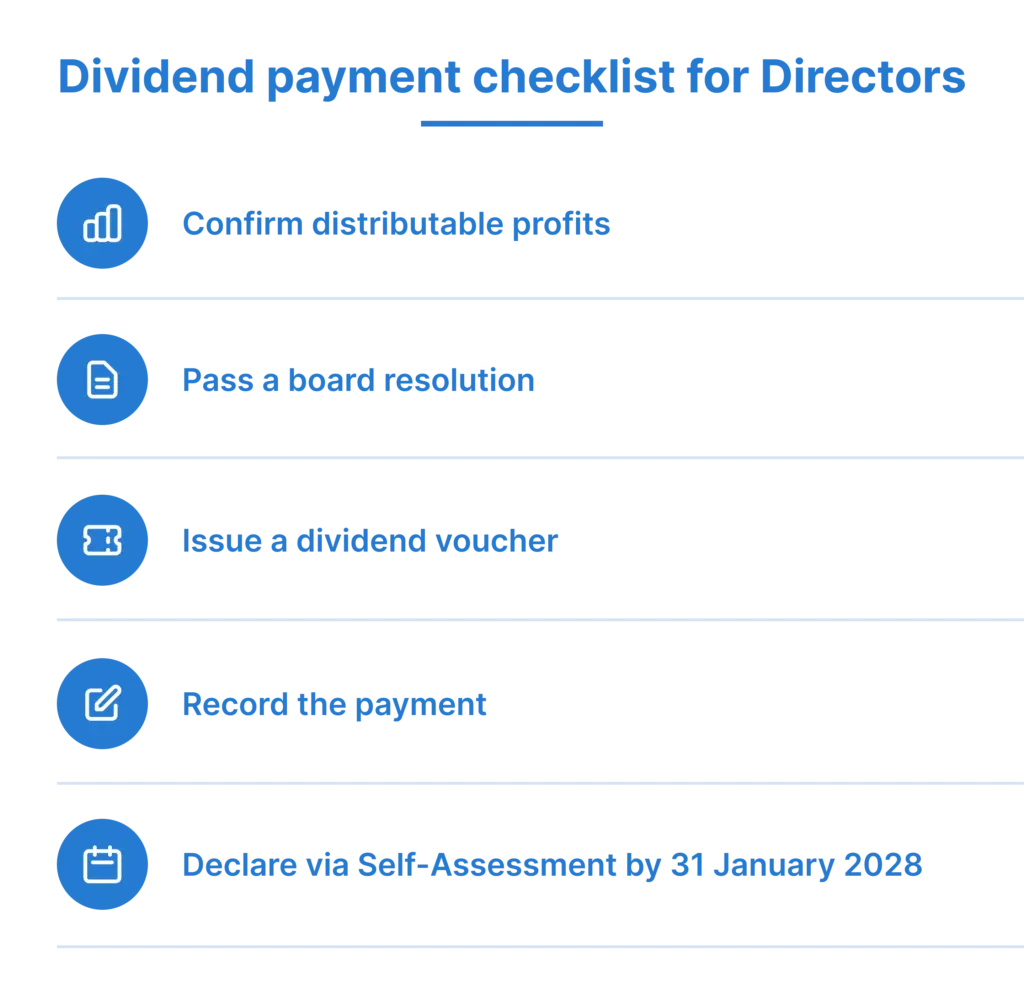
- Prepare or update management accounts to confirm distributable profit is sufficient
- Hold a board meeting and pass a resolution approving the dividend
- Issue a dividend voucher to each shareholder showing the date, company name, shareholder name and amount per share
- Make the payment and record it in the company’s books
- Each shareholder reports the dividend through Self-Assessment where required
This process applies to both interim and final dividends. Skipping any step, particularly the board resolution or voucher can leave the dividend open to challenge.
What happens if it goes wrong?
- Any director’s loan above £10,000 on which no interest is charged at HMRC’s official rate creates a Benefit-in-Kind charge, which must be reported through P11D.
- A loan outstanding nine months and one day after year end is subject to a Section 455 charge of 35.75% where the relevant 2026/27 rate applies,
- Under section 847 of the Companies Act 2006 a shareholder who knew or should have known the dividend was unlawful is personally liable to repay it.
The correct process
Before each dividend is declared the company needs up-to-date management accounts confirming distributable profit, a board resolution approving the payment and a dividend voucher recording the date, company name, shareholder name and amount.
Every dividend declaration should follow this process and the company should retain the supporting records.
Any dividend paid outside this process risks being treated as an amount owed to the company rather than a valid dividend.
What has changed from April 2026?
The main change for directors is that dividend tax rates increased from 6 April 2026, while the main Personal Allowance and Dividend Allowance remain unchanged. Employer National Insurance also continues at 15% with the Secondary Threshold at £5,000.
- Dividend tax rates increased from 8.75% to 10.75% at the basic rate and from 33.75% to 35.75% at the higher rate from 6 April 2026. For a basic rate taxpayer taking £30,000 of dividends above the Dividend Allowance, the 2 percentage-point increase represents around £590 of additional dividend tax compared with the previous rate.
- The Secondary Threshold remains at £5,000 following its reduction from £9,100 in April 2025. For sole directors without the Employment Allowance, every pound of salary above this figure costs the company 15% in Employer National Insurance before considering the Corporation Tax deduction.
- The Personal Allowance and Dividend Allowance remain at £12,570 and £500 respectively for 2026/27.
How does Dividend Income get reported to HMRC?
It does not go through payroll. Any amount above the £500 Dividend Allowance may need to be reported through Self-Assessment, depending on your overall income and circumstances, and the filing and payment deadline for 2026/27 is 31 January 2028.
Directors not yet registered for Self-Assessment need to do so well before that date. HMRC does not automatically collect all dividend tax through PAYE, so the individual is responsible for reporting and paying any tax due.
When do Pension Contributions make more sense than extra Dividends?
For directors already in the higher rate band at 35.75%, an employer pension contribution can be more tax-efficient than taking the same amount as a dividend, depending on the individual’s circumstances and available pension allowances.
A contribution paid directly from the company can reduce taxable profit. The Corporation Tax saving is between 19% and 25% depending on company profit levels. It carries no National Insurance and does not count as personal taxable income when structured as an employer pension contribution, so no dividend tax applies to the contribution itself.
The numbers at higher income levels
For a director with total income of £55,000, redirecting £5,000 into a pension rather than taking it as a dividend can avoid dividend tax on the amount that would otherwise be extracted as a dividend, while the company may also obtain Corporation Tax relief on the contribution, subject to the relevant pension rules.
For directors with income approaching £100,000, pension contributions can reduce adjusted net income, which is total income minus contributions and certain reliefs. The Personal Allowance tapers once adjusted net income exceeds £100,000 and disappears entirely at £125,140. A pension contribution can restore part of that allowance, producing a saving beyond the Corporation Tax relief.
The annual pension allowance for 2026/27 is £60,000. Any unused allowance from the previous three tax years can potentially be carried forward, provided the relevant conditions are met. This allows a larger pension contribution in a more profitable year.
Conclusion
The salary vs dividends question is not a one-time decision. The right salary level, Employment Allowance position, correct dividend process and whether pension contributions make better use of higher-rate profits all shift as the business grows and tax rules change.
For many limited company directors and shareholders in 2026/27, a £12,570 salary combined with dividends from remaining profits is a common tax-planning starting point rather than a universal answer. The April changes have made the detail more consequential, particularly because dividend tax rates have increased while key allowances remain unchanged.
Daniel Wolfson & Co advises limited company directors and shareholders across North-west London on remuneration planning, year-end accounts and personal tax returns. Call 01923 856 008 or email office@danielwolfson.co.uk to speak with the team.
Frequently Asked Questions
Is it better to take salary or dividends in 2026/27?
For many limited company directors, a combination of salary and dividends is more tax-efficient than taking everything as salary. The exact mix depends on company profits, Employment Allowance and the director’s other income.
How much salary should a director take in 2026/27?
£12,570 is a common starting point, but sole directors should also compare lower salary levels because employer National Insurance applies above £5,000 where Employment Allowance is unavailable.
Should I take £12,570 salary and the rest as dividends?
Often, but not always. It can be attractive where the director has no significant other income and the company can benefit from the salary deduction. A sole director without Employment Allowance should compare the numbers before deciding.
What is the dividend tax rate in 2026/27?
The dividend rates are 10.75% for basic-rate taxpayers, 35.75% for higher-rate taxpayers and 39.35% for additional-rate taxpayers, after the £500 Dividend Allowance.
Can a director receive dividends without being a shareholder?
No. Dividends are paid to shareholders according to their shareholding and the rights attached to their shares.
Can I take dividends if my company made a loss this year?
Potentially, if the company has sufficient distributable profits brought forward from previous periods. A current-year loss does not automatically mean dividends are impossible, but the company’s overall distributable reserves must be sufficient.
Does taking dividends affect a mortgage application?
It can. Lenders have different approaches to salary, dividends and retained company profits, so directors should check the lender’s criteria rather than assuming all dividend income will be treated in the same way.
Do dividends count towards National Insurance?
No. Dividends do not attract employee or employer National Insurance.
What happens if I have another job?
Your other employment income uses part of your Personal Allowance and tax bands, which can change the most efficient salary and dividend mix from your limited company.
What happens when my income approaches £100,000?
The Personal Allowance begins to taper once adjusted net income exceeds £100,000 and is fully withdrawn at £125,140.
At this level, pension contributions can become particularly valuable as part of wider tax planning.
Does the salary-and-dividend split differ for Scottish directors?
Yes. Dividend tax rates are UK-wide, but Scottish Income Tax rates on salary and other non-savings income differ from those in England, Wales and Northern Ireland. This can change the most efficient extraction strategy.
About the Author