Hiring an accountant can help a business manage tax returns, accounts and financial reporting when the workload or complexity grows. The right time depends on the business structure, compliance responsibilities and the financial information needed for decisions. For many owners, the question is whether targeted accountant services or ongoing accounting services for businesses would provide better value.
Not every UK business needs to hire an accountant, but every business must meet the accounting, tax and filing requirements that apply to it. Limited companies have statutory reporting obligations, while sole traders must maintain appropriate records and report their taxable income.
If you are considering accounting support for a business, this guide explains the signs to look for, the responsibilities that apply to each business structure, how in-house and paid accounting compare, and what to check before choosing an accountant.
Key Takeaways
- Limited companies must meet statutory accounts, Companies House and Corporation Tax requirements whether or not they appoint an accountant.
- VAT registration, payroll and expansion can increase the amount of accounting work a business needs to manage.
- Unclear cash flow, incomplete records and time-consuming bookkeeping can indicate a need for professional support.
- Businesses can hire an accountant for specific tasks, such as year-end accounts and tax returns, without outsourcing all bookkeeping.
- Before appointing an accountant, confirm the service scope, fees, deadline responsibilities and records the business must provide.
What are the Signs that your Business needs an Accountant?
You may need an accountant when tax and reporting requirements become harder to manage, financial records are unreliable or accounting tasks take time away from running the business. The signs below show where professional support may help.
| Sign | What it may indicate | Support to consider |
|---|---|---|
| Incorporating a limited company | New statutory accounts and tax reporting duties | Year-end accounts and tax returns |
| New VAT or payroll responsibilities | More reporting and payment deadlines | VAT returns and payroll |
| Self-employed or landlord income above £50,000 | Making Tax Digital for Income Tax: digital records and quarterly updates | Software set-up and quarterly reporting support |
| Receiving a penalty notice from HMRC or Companies House | A gap in deadline tracking or filing processes | Deadline management and compliance support |
| Strong revenue but unclear cash or profit | Costs, tax and unpaid invoices not tracked against income | Cash-flow forecasts and management accounts |
| Accounting work taking too much time | Bookkeeping delays other business tasks | Bookkeeping and reconciliation support |
| Returns prepared from incomplete records | Missed expenses and overpaid tax | Records review and tax return preparation |
| Plans for expansion or borrowing | A need for reliable forecasts and cost information | Budgeting and financial reporting |
Each sign points to a different need. The details below explain when professional help may be useful and which tasks could be delegated.
A change in business structure
When a sole trader incorporates, the company must file annual accounts with Companies House and a Company Tax Return with HMRC, and Corporation Tax payment deadlines are separate from the filing deadline.
An accountant can prepare the accounts and return and help set up a deadline process, but the director remains legally responsible.
New VAT, payroll or Making Tax Digital responsibilities
VAT registration and employing staff introduce recurring calculations, reports and deadlines. A UK business must register for VAT if taxable turnover exceeds £90,000 over a rolling 12-month period, or is expected to exceed £90,000 in the next 30 days alone. The two tests apply in different circumstances, so check which one applies. Employers operating PAYE must report employees’ pay and deductions to HMRC on or before payday, and workplace pension duties may also apply.
From 6 April 2026, self-employed individuals and landlords with qualifying income above £50,000 must keep digital records and send quarterly updates to HMRC under Making Tax Digital for Income Tax. The threshold falls to £30,000 from April 2027, so businesses that currently file one annual return may need new software and processes in place before their start date.
An accountant or specialist provider can manage agreed tasks such as VAT returns, payroll processing and MTD quarterly updates. This accounting support for a business can help when the owner cannot manage the additional responsibilities accurately and on time.
Financial records no longer explain the business’s position
High sales do not always mean a business has enough cash to pay its bills. Late customer payments, higher supplier costs and upcoming tax bills can leave a business short of cash, even when sales are growing. For example, a North-West London wholesaler making £40,000 in monthly sales may struggle to pay suppliers within 14 days if customers have 30 days to pay and two large invoices remain unpaid.
Revenue is not the same as profit. A business invoicing £8,000 a month may have £2,000 or less left after paying for software, subcontractors, home office costs and tax. A cash-flow forecast helps identify when cash may run short, while management accounts show profit margins, unpaid customer invoices and business costs.
Financial administration is taking time away from operations
Bookkeeping, invoice tracking and bank reconciliations require regular attention. If these tasks repeatedly delay sales follow-ups, customer service or operational decisions, the business may need additional support.
For example, an owner who spends every Friday reconciling transactions has less time to follow up quotations or review overdue customer accounts. Outsourcing bookkeeping may return some of that time to the business, provided the service covers the tasks causing the delay.
Financial administration is taking time away from operations
Bookkeeping, invoice tracking and bank reconciliations need regular attention. If they repeatedly delay sales follow-ups or customer service, outsourcing bookkeeping may return that time, provided the service covers the tasks causing the delay.
Growth plans require better financial information
Recruitment, expansion and borrowing decisions need a clear view of costs, profitability and future cash requirements. An accountant can prepare or review budgets, forecasts and management reports, depending on the agreed service.
How does Business Structure affect the need for an Accountant?
Business structure determines a business’s reporting obligations and the accounting support it may need. A limited company has statutory filing requirements, while a sole trader’s needs depend on the complexity of their finances and business activities.
The table below outlines the main reporting requirements for each structure and where an accountant can provide specific support.
| Business structure | Main reporting requirements | When an accountant can help |
|---|---|---|
| Limited company | Annual accounts, Company Tax Return and confirmation statement | Preparing statutory accounts, calculating Corporation Tax and meeting filing deadlines |
| Sole trader | Self Assessment tax return and business records | Checking allowable expenses, preparing tax returns and assessing VAT obligations |
| Sole trader considering incorporation | Personal tax reporting and company reporting after incorporation | Comparing the tax and administrative implications using actual business figures |
| Partnership | Partnership tax return and individual partners’ tax returns | Allocating profits, preparing tax returns and accounting for changes in partners’ shares |
The need for an accountant also depends on the decisions a business faces.
For example, a sole trader considering incorporation may need to compare the tax and administrative costs, while a limited company director may need help distinguishing Corporation Tax payment deadlines from Company Tax Return filing deadlines.
This advice helps business owners make informed decisions based on their actual circumstances.
What are the risks of waiting too long to hire an Accountant?
Delaying professional support is not necessarily a problem when records are accurate and deadlines are under control. Risk increases when filing obligations are overlooked, records remain incomplete or tax liabilities are not planned for.
Late filing penalties
Companies House and HMRC apply separate penalties for late annual accounts and Company Tax Returns. A penalty notice is often the first sign that a deadline or process is not being managed.
Companies House late accounts penalties
| How late the accounts are | Penalty |
|---|---|
| Up to one month | £150 |
| More than one month and up to three months | £375 |
| More than three months and up to six months | £750 |
| More than six months | £1,500 |
The penalty doubles if accounts are filed late in two consecutive financial years.
HMRC Company Tax Return late filing penalties
For returns with filing dates on or after 1 April 2026:
| When the return is late | Fixed penalty |
|---|---|
| Within three months of the deadline | £200 |
| More than three months after the deadline | £400 |
Further tax-related penalties may apply if the return remains outstanding and Corporation Tax is unpaid.
Sole traders face a separate penalty for late Self Assessment returns: £100 immediately, even if no tax is owed, with daily and percentage-based penalties building from three months and further charges at six and 12 months.
Cash-flow pressure from unplanned tax payments
Tax payments can become difficult to manage when cash is tied up in unpaid invoices or committed to operating costs.
Regular bookkeeping and cash-flow forecasting help estimate upcoming liabilities and show whether funds need to be set aside.
Time-consuming corrections
Missing invoices, unreconciled transactions and miscategorised expenses can delay year-end work and give the accountant more to clarify before the accounts and returns are completed.
Keeping records up to date throughout the year helps, and professional support cannot replace the business’s responsibility to provide reliable information.
Is it worth hiring an accountant instead of managing accounts in-house?
To decide whether hiring an accountant is worthwhile, compare the time spent on accounting and the total cost of managing it internally with the fee for the service required.
The comparison should also consider the risk of errors and whether the current records provide useful financial information. An accountant should be assessed on the tasks included in the engagement, not simply the size of the package.
Calculate the time and cost of managing accounts
Record the hours spent each month on bookkeeping, bank reconciliations, invoice tracking, filing preparation and correcting errors. Include time spent reading tax guidance, responding to queries and locating missing documents.
Use the worksheet below to calculate the monthly workload.
| Task | Hours this month | Could someone else handle it? |
|---|---|---|
| Bookkeeping and receipts | _____ | _____ |
| Invoicing and chasing payments | _____ | _____ |
| VAT return preparation | _____ | _____ |
| Payroll | _____ | _____ |
| Reading guidance or answering HMRC letters | _____ | _____ |
| Preparing figures for a lender or adviser | _____ | _____ |
| Total | _____ |
Once the hours are recorded, estimate the opportunity cost of that time.
- Add the hours spent on accounting work during the month.
- Estimate the value of one hour of that time, using an appropriate billing rate or the value of other work that could be completed.
- Multiply the hours by that hourly value.
- Compare the result with an accountant’s quote for a clearly defined service.
For example, a small consultancy spends 10 hours a month on bookkeeping and preparing records. If the owner values that time at £30 an hour, the estimated opportunity cost is £300 a month. If an accountant quotes £220 a month for a service covering those tasks, the business can compare the potential saving with any work that remains in-house.
These figures are hypothetical. The actual value depends on the owner’s working hours, internal costs and the services included in the quote. The comparison should also account for any additional fees and the time needed to share records with the accountant.
Compare responsibilities, not just fees
A lower fee may cover annual accounts only, while a broader package may include bookkeeping, VAT returns, payroll or regular reporting.
| Managing accounts in-house | Using an accountant |
|---|---|
| The owner or team maintains records and prepares agreed submissions. | The accountant handles the tasks included in the engagement. |
| The business tracks requirements and filing deadlines. | The accountant supports the agreed filing and reporting work. |
| Staff time is needed for checks, reconciliations and corrections. | Some administration can be delegated, but the business must still supply records. |
| Reporting depends on internal time and expertise. | Additional reporting or advice may be available if included in the fee. |
Before accepting a quote, check whether it covers bookkeeping, year-end accounts, Corporation Tax returns, VAT, payroll and advice. Compare accountant services in the UK by scope and fee rather than price alone. Confirm additional charges, who will monitor each deadline and which tasks remain the business’s responsibility.
Consider the potential cost of errors
A missed filing can lead to penalties, while poor records can make it harder to assess profitability or plan tax payments. An accountant may help reduce these risks and identify applicable tax reliefs, but tax savings are not guaranteed.
Allowable expenses are easy to miss when records are incomplete. Common examples include a proportion of home working costs, business mileage at HMRC approved rates, professional subscriptions, equipment and relevant training. For example, a 40% taxpayer who misses £3,000 of allowable expenses pays £1,200 more tax than necessary.
The decision should reflect both the time saved and the value of the agreed service. Hiring an accountant does not automatically cost less than managing accounts in-house, and a business with straightforward finances may not need ongoing support.
What does an Accountant do for a Business after being Hired?
An accountant’s role depends on the agreed service. Some businesses need help with annual compliance, while others require regular bookkeeping and financial reporting. A clear agreement establishes what the accountant will handle and what the business must continue to do.
Review the existing records
The accountant reviews previous accounts, returns and outstanding filings to find gaps, and both sides agree how records are shared and who approves submissions.
Prepare accounts and tax returns
Depending on the service, an accountant prepares year-end accounts, calculates Corporation Tax and prepares the Company Tax Return. The owner or director must provide accurate records, respond to queries and review the information before submission.
Provide ongoing financial reporting
Management accounts and cash-flow forecasts help businesses monitor costs, profitability and available funds, and support decisions on recruitment, pricing and borrowing.
Plan tax and handle HMRC queries
An accountant can review the business’s position before the tax year ends, for example on pension contributions before 5 April or a director’s salary and dividend split. If HMRC questions a return or opens an enquiry, an accountant authorised as agent can respond on the business’s behalf, depending on the agreed service.
How should you prepare before Hiring an Accountant?
A clear picture of the current accounts and outstanding responsibilities helps an accountant assess the work involved and provide a more accurate quote. Records do not need to be perfect before the first discussion, but gaps and unresolved issues should be disclosed.
Information to gather
- Business structure and company registration details, where applicable.
- Previous annual accounts, tax returns and relevant HMRC correspondence.
- Bank statements, sales invoices, purchase invoices and expense records.
- Current bookkeeping software and the process used to maintain records.
- VAT registration and returns, payroll records and other relevant tax information.
- Outstanding filings, unreconciled transactions and known record-keeping problems.
- The main requirements, such as year-end compliance, bookkeeping, payroll or cash-flow reporting.
Before appointing an accountant, it is also important to understand what the service includes, how fees are structured and who will be responsible for meeting filing deadlines.
Use the following checklist to compare your options and clarify expectations before making a decision.
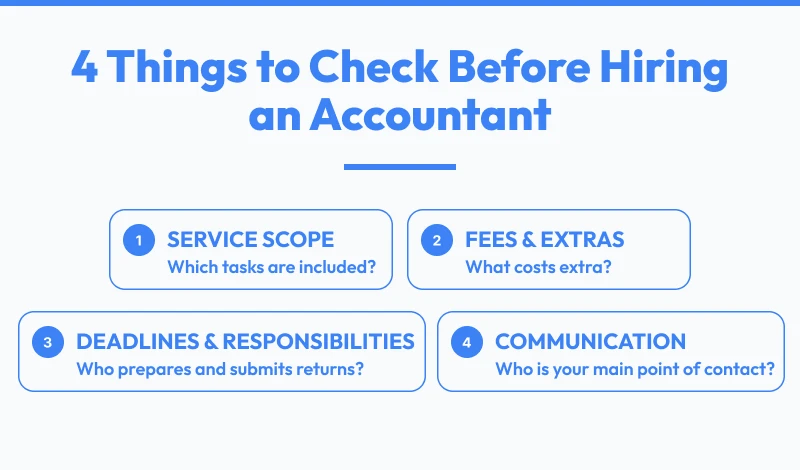
Once these points are clear, prepare your business records and list any outstanding filings before the first meeting. This will help the accountant understand your requirements, assess the work involved and provide a more accurate quote.
How can Daniel Wolfson & Co help with your Accounting Needs?
If your business needs support with year-end accounts, tax returns or ongoing accounting work, first identify which responsibilities you want to retain in-house and which you want to delegate.
Daniel Wolfson & Co provides professional accountancy services for businesses. The firm works with small businesses and sole traders across Hertfordshire and North-West London. The right accountant for your business should offer a clear scope of work and communication arrangements.
Conclusion
Hiring an accountant depends on your workload, compliance responsibilities and need for reliable financial information. A sole trader with straightforward records may manage routine tasks independently, while a limited company with additional reporting obligations may benefit from professional support.
Review the time spent maintaining records, the deadlines that apply and the financial information needed for business decisions. If the workload or complexity is increasing, compare the cost of accounting support with the time and effort required in-house. Check whether the accountant services offered match the support your business needs.
Book a consultation with Daniel Wolfson & Co to discuss your business’s accounting needs or email office@danielwolfson.co.uk.
Frequently Asked Questions
When should I hire an accountant?
Consider hiring an accountant when company reporting, VAT, payroll or tax returns become difficult to manage or when accounting work takes time away from business operations. Professional support may also help when preparing for expansion or seeking finance.
Do I need an accountant if I run a small business?
No, appointing an accountant is not a legal requirement for every small business. You may manage your own records and tax obligations if you understand the rules that apply and meet the deadlines. Professional support can help when responsibilities become more complex.
What is the difference between a bookkeeper and an accountant?
A bookkeeper records day-to-day transactions and keeps the books up to date. An accountant reviews those records, prepares accounts and tax returns and advises on tax and financial decisions. Many businesses need both, and some accountants offer bookkeeping as part of their service.
Can I hire an accountant halfway through the financial year?
Yes, an accountant can be appointed during the financial year. They may review existing records, identify outstanding tasks and agree on responsibility for upcoming filings. Disclose previous submissions, unreconciled transactions and approaching deadlines at the start.
Can an accountant help if my business has already received an HMRC penalty?
Yes, an accountant can review what caused the penalty, deal with HMRC on your behalf once authorised and set up a process to avoid a repeat. Some penalties can be appealed if there is a reasonable excuse, but the outcome depends on the circumstances.
Does a dormant limited company still need to file accounts?
A dormant company still needs to file annual accounts with Companies House and submit a confirmation statement. Its Corporation Tax obligations depend on its circumstances and HMRC’s requirements, so dormancy should not be assumed to remove every filing responsibility.
Should a new business hire an accountant?
A new business may manage straightforward records in-house, but should understand its tax and filing responsibilities from the start. An accountant may help establish record-keeping processes, register for relevant taxes and prepare required submissions.
What should I check before choosing a business accountant?
Check the accountant’s relevant experience, qualifications or professional membership, service scope, fees and communication arrangements. Confirm which filings are included, who will manage the account and what records the business must supply.
About the Author