A contractor needs an accountant who can manage the financial responsibilities of their work, from recording income and expenses to preparing tax returns and meeting filing deadlines. The accounting support required depends on whether the contractor works through a limited company, operates as a sole trader or receives payments through an umbrella company.
For limited company contractors, this involves keeping company records separate from personal finances, preparing annual accounts, calculating Corporation Tax and managing payments made to the director. VAT, payroll, Self Assessment and IR35 requirements may also need attention, depending on the business and its contracts.
This guide covers what each area involves, how IR35 changes what an accountant can and cannot do for you, which contractor expenses are claimable and what records support them and which support suits each stage of contracting. It also covers how sole trader contractors differ, when bookkeeping support is worth having and how to check what a fee actually includes.
Key takeaways
- Limited company contractors need support with annual accounts, Corporation Tax, bookkeeping and Companies House filings.
- Salary and dividend decisions affect personal tax, so withdrawals should be planned around company profits and the director’s circumstances.
- VAT registration becomes compulsory when taxable turnover exceeds £90,000 over a rolling 12-month period or is expected to exceed this amount in the next 30 days.
- IR35 status depends on the terms and working practices of each contract, not simply on whether a contractor works through a limited company.
- A contractor accountant should provide more than year-end filing. Regular bookkeeping, tax planning and advice can help keep financial records accurate throughout the year.
What does a Contractor Accountant do?
A contractor accountant manages the financial and tax responsibilities that come with working independently. The work can cover day-to-day bookkeeping, statutory accounts, tax calculations, payroll and advice on how to manage payments from the company.
The level of support depends on whether the contractor operates through a limited company or as a sole trader. A limited company has its own reporting and tax obligations, so its accounts must be maintained separately from the director’s personal finances.
The main contractor accountant services include:
| Accounting service | What it covers |
|---|---|
| Bookkeeping | Recording sales invoices, business expenses, supplier payments and bank transactions. |
| Annual accounts | Preparing statutory accounts from the company’s financial records. |
| Corporation Tax | Calculating the company’s taxable profits and preparing the Corporation Tax Return. |
| Payroll | Processing director or employee salaries and managing PAYE submissions. |
| Dividend records | Recording dividend payments and maintaining the supporting paperwork. |
| VAT | Managing VAT registration, returns and payment records where the company is registered. |
| Self Assessment | Preparing the director’s personal tax return where one is required. |
| Company secretarial support | Helping with statutory company records and relevant filing responsibilities. |
A contractor who receives payments from several clients, pays for software and equipment and takes money from the company through salary and dividends needs these transactions recorded correctly. The accountant uses those records to prepare the company’s accounts and calculate its tax liabilities.
What Accounting Support does a Limited Company Contractor need?
A limited company contractor has responsibilities at both company and personal level. The company must maintain its own records, report its profits and meet filing deadlines. The director must also account for personal income received from the company.
The following services form the core of accounting support for many limited company contractors.
Annual accounts and Corporation Tax
Corporation Tax is charged at 19% on profits up to £50,000 and 25% on profits above £250,000, with marginal relief between the two. If the company has associated companies, both limits are divided between them, so a director who controls two companies gets lower limits in each.
Take a company with £60,000 of profit and no associated companies. At 25% the tax would be £15,000, but marginal relief of £2,850 applies, calculated as 3/200 of the £190,000 gap to £250,000. The bill is £12,150, an effective rate of 20.25%.
Contract income is uneven, so year-end profit can be difficult to judge until the final invoice is paid. Your accountant should give you a Corporation Tax estimate before year end, while you can still choose between buying equipment the company needs and keeping the cash for the tax bill. The accounts and the tax return use the same figures, so preparing them together avoids two sets of figures.
Director pay: Salary, Dividends and Self Assessment
Directors of limited companies can take income through a combination of salary and dividends. Salary is treated as a business expense and can reduce the company’s taxable profits. Dividends, however, are paid from profits after Corporation Tax and do not reduce the company’s taxable profits.
Dividends are taxed as personal income. For the 2026/27 tax year (6 April 2026 to 5 April 2027), the first £500 is tax-free. Any amount above this is taxed at 10.75% for basic-rate taxpayers, 35.75% for higher-rate taxpayers and 39.35% for additional-rate taxpayers.
For example, a director receiving a £12,570 salary and £30,000 in dividends has a total income of £42,570. Assuming no other income or allowances affect the calculation, the dividend tax would be:
| Calculation | Amount |
|---|---|
| Total dividends | £30,000 |
| Dividend allowance | £500 |
| Taxable dividends | £29,500 |
| Tax at 10.75% | £3,171.25 |
The director reports this dividend income through their Self Assessment tax return. Keeping salary records, dividend vouchers and company accounts up to date helps ensure the figures are reported correctly.
VAT
A limited company must register for VAT if its taxable turnover exceeds £90,000 over a rolling 12-month period. Registration is also required if the company expects its taxable turnover to exceed £90,000 in the next 30 days alone.
Contractors with irregular or high-value invoices need to keep track of their taxable turnover to check whether they are approaching the registration threshold. An accountant can help monitor turnover and advise when registration is required.
Once registered, the company must submit VAT returns and pay any VAT due. An accountant can also help assess whether the Flat Rate Scheme is suitable, based on the type of business and its VAT-inclusive costs.
How does IR35 affect Contractors?
IR35 and the off-payroll working rules affect how income from certain contracting engagements is taxed. They apply when a worker provides services through an intermediary but would be treated as an employee for tax purposes if they worked directly for the client.
The rules do not apply automatically to every contractor. The employment status assessment depends on the working relationship for the engagement, including factors such as control, personal service, substitution rights and the wider working arrangements.
Who is responsible for deciding whether IR35 applies?
Responsibility for the employment-status decision depends on whether the client is in the public sector or private sector and, for private sector clients, whether it meets the relevant size conditions.
| Client type | Responsibility for the status decision |
|---|---|
| Public sector client | The client is responsible for determining employment status. |
| Medium or large private sector client | The client is responsible for determining employment status. |
| Small private sector client | The contractor’s intermediary is responsible for determining employment status. |
For public sector and medium or large private sector engagements, the client must provide a Status Determination Statement explaining its conclusion and the reasons for it. The fee-payer in the payment chain is responsible for applying the relevant tax and National Insurance deductions when the off-payroll rules apply.
For a small private sector client, the responsibility for the status decision remains with the contractor’s intermediary. The contractor must consider the actual working arrangements and the relevant employment-status factors.
The decision may differ between engagements. A contractor providing services to a small business may be responsible for the status assessment, while a separate engagement with a large organisation may require the client to make the determination.
What should your accountant handle in relation to IR35?
An accountant can help maintain the financial records for each engagement and reflect the relevant payment treatment in the company’s accounts. This includes recording income received, identifying deductions made by a fee-payer and keeping the supporting documents for the accounting period.
The working arrangements also matter when considering employment status. Control over how and when work is completed, whether personal service is required and whether a genuine right of substitution exists may all be relevant. The wording in the contract should be considered with the way the engagement operates in practice.
A formal status assessment or legal opinion may require specialist advice. Before relying on an accountant for an IR35 review, check whether the service includes a full employment-status assessment, a contract review or only general accounting guidance. The scope of the work should be clear before the engagement begins.
Which Contractor Expenses can the company claim and what records support them?
A limited company contractor can claim qualifying business expenses such as software subscriptions, equipment, business insurance, professional fees and certain travel costs. Each expense must meet HMRC’s rules for Corporation Tax relief. Equipment may qualify for capital allowances rather than being deducted as an ordinary business expense.
Travel to a contract site
Travel to a temporary workplace can qualify for tax relief. Under HMRC’s 24-month rule, a workplace is generally treated as permanent if the contractor expects to work there for more than 24 months and spends 40% or more of their working time at that location. Both conditions must be met for this rule to apply.
For example, a contractor attending a client site three days a week under a 12-month contract may qualify for travel relief. If the contract is expected to last 30 months and the contractor spends 60% of their working time there, the site is generally treated as permanent from day one. However, if the contractor attends the same site one day a week, representing 20% of working time, the 40% condition is not met. The wider temporary workplace rules must still be considered before claiming travel relief.
Contracts change after signing. If a 12-month contract is extended to 30 months, the site can become a permanent workplace from the point the extension is expected, so tell your accountant when an end date changes.
When a limited company director uses their personal car or van for qualifying business journeys, the company can reimburse mileage at HMRC’s approved rates for 2026/27:
| Business mileage | Approved rate |
|---|---|
| First 10,000 miles | 55p per mile |
| Above 10,000 miles | 25p per mile |
For example, 12,000 qualifying business miles result in £6,000 in mileage reimbursement (£5,500 for the first 10,000 miles and £500 for the remaining 2,000 miles).
These rates cover the vehicle’s running costs, so fuel, repairs and insurance cannot be claimed separately for the same mileage. Maintain a mileage log showing journey dates, destinations, business reasons and distances.
Records your accountant needs
Accurate records help your accountant check whether an expense qualifies for tax relief and prepare the company accounts correctly. The following five records are particularly useful for contractor expense claims.
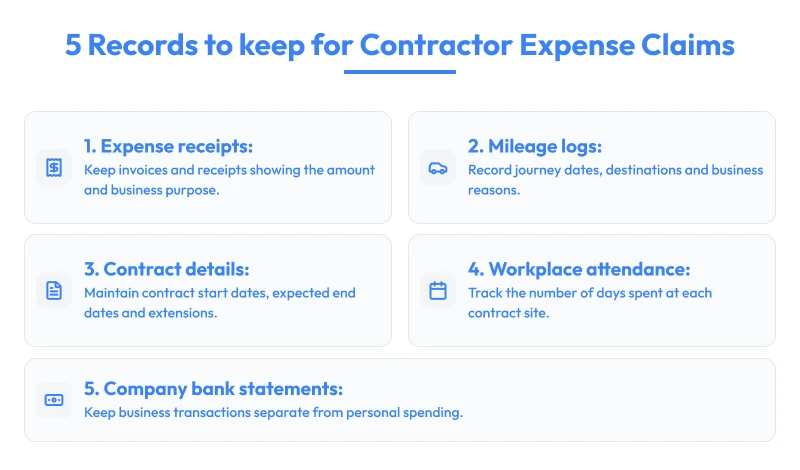
Keep these records updated throughout the year rather than collecting them only when annual accounts are due. Inform your accountant about changes to contract duration, client locations and IR35 status, as these can affect which travel costs qualify for tax relief.
What support do you need at each stage of contracting?
A contractor accountant’s work changes at four points: before the first contract, when the first accounts are due, as turnover nears £90,000 and during a gap between contracts. The gap is the least obvious, because invoices stop while filing dates continue. Each stage adds a task that should already be on your accountant’s schedule:
| Stage | What changes | Support to ask for |
|---|---|---|
| Before the first contract | You choose a structure and register the company | Company formation, HMRC registrations and advice on a company bank account |
| First year of trading | First payroll, first dividends, first accounts | Bookkeeping, director payroll, dividend paperwork, first accounts and Corporation Tax return |
| Turnover nearing £90,000 | VAT registration becomes compulsory at £90,000 | Turnover tracking, registration timing, VAT scheme advice and returns |
| Gap between contracts | Invoices stop, filing dates continue | Confirmation of which filings still apply, a cash plan for the next tax bills, bookkeeping at lower volume |
| Closing the company | Final accounts and distribution of remaining funds | Final accounts and tax advice on the closing distribution before you start |
Does a Sole Trader Contractor need different Accounting Support?
Generally yes, a sole trader contractor has no company accounts, no Corporation Tax and no director payroll, because profit is taxed on you through Self Assessment.
The main addition is Making Tax Digital (MTD) for Income Tax, which depends on qualifying income. The two structures differ in how profit is taxed and what gets filed:
| Area | Limited company contractor | Sole trader contractor |
|---|---|---|
| Tax on profit | Corporation Tax on company profit, then personal tax on salary and dividends | Income Tax and National Insurance on business profit |
| Annual filings | Statutory accounts, Corporation Tax return and your personal return | One Self Assessment return including business figures |
| Payroll | Director salary through PAYE | None for yourself |
| Making Tax Digital | MTD for VAT if VAT-registered | MTD for Income Tax if qualifying income passes the threshold |
MTD for Income Tax uses qualifying income, which is gross income from self-employment and property before expenses, not profit.
The thresholds are over £50,000 from April 2026, over £30,000 from April 2027 and over £20,000 from April 2028. Dividends from your own company are generally not counted. A sole trader contractor invoicing £55,000 with £20,000 of costs has £35,000 profit but £55,000 qualifying income, so the threshold is tested against the larger figure.
Do you need Bookkeeping Support as well as an Accountant?
Many contractors keep their own books while invoicing is simple. Payroll, VAT returns and a monthly bank reconciliation usually make professional contractor bookkeeping a sensible choice. The question to answer is who produces the figures your accountant relies on, because every filing is built from them.
There are three ways to handle it:
- Do it yourself in cloud software such as FreeAgent or Xero, which suits low invoice volumes and few expenses.
- Keep the books yourself and have your accountant review them at set intervals, which can catch miscoded expenses before they reach the accounts.
- Give bookkeeping to your accountant entirely, which suits contractors who bill through several agencies or run VAT and payroll.
Whichever route you choose, record each invoice and expense as it happens and reconcile the company bank account every month. A £600 difference between the ledger and the bank is simple to correct in the month it appears and slow to trace twelve months later.
How do you check what a Contractor Accountant’s service covers?
Ask the contractor accountant for a written list of what the fee includes, matched against accounts and Corporation Tax, payroll, VAT, Self Assessment and Companies House filings. Scope varies between providers and some place VAT or Self Assessment in a higher package or charge for it separately. A lower fee that leaves out VAT returns and Self Assessment can cost more than a higher fee that includes both.
Before signing, confirm:
- Which of accounts, Corporation Tax, payroll, VAT and Self Assessment are inside the fee
- Whether they act as your agent with HMRC and handle its letters
- What their IR35 advice covers and who they refer you to for a contract review
- Which accounting software they use and whether you get access to it
- Their professional body, such as ICAEW, ACCA, AAT or IFA, which you can confirm in the body’s own directory
- Who answers your questions and how quickly
Conclusion
A contractor accountant is most useful when accounts, Corporation Tax, director pay, personal tax and VAT are prepared from the same figures, with IR35 status and expense records kept up to date for each contract. Knowing who decides IR35 status, which costs the company can claim and when VAT registration is required helps a limited company contractor plan tax bills before they are due. Support needs change as turnover grows and contracts end, so it helps to confirm in writing what the fee covers before signing.
If your limited company needs accounting support, Daniel Wolfson & Co supports limited companies with annual accounts, Corporation Tax, payroll, VAT and Self Assessment and includes IR35 advice. To see which of these your contracts need, book a consultation or email office@danielwolfson.co.uk.
FAQs
Do I still need a contractor accountant between contracts?
Generally yes, because the company still files accounts, a Corporation Tax return and a confirmation statement. Payroll also continues if you pay a salary. Fewer invoices reduce bookkeeping but not deadlines, so ask which filings still apply.
Do I need an accountant if I work through an umbrella company?
Often much less, because an umbrella company employs you and runs your payroll, so there are no company accounts or Corporation Tax to file. You may still need a Self Assessment return if you have other income to report.
Can the company register for VAT before reaching £90,000?
Yes, voluntary registration is allowed below the threshold and lets the company reclaim VAT on its costs. The company must also charge VAT on invoices, which can be a disadvantage when the business you contract for cannot reclaim it.
Can I switch accountants during the year?
Yes, your new accountant contacts the current one for a handover. Have your bank statements, last filed accounts and payroll records ready so nothing is rebuilt. Switching before year end leaves time to review the books.
How often should I send my accountant my records?
Monthly suits many contractors because payroll runs monthly and VAT returns are usually quarterly. Send invoices, receipts and mileage entries as they arise and agree a fixed cut-off date each month so nothing waits until year end.
Do I need to tell my accountant when a contract changes?
Yes, tell them as soon as a start date, end date, extension or client changes. Each can alter the 24-month travel test, your IR35 status or your VAT turnover forecast, so the numbers need rechecking.
About the Author