Choosing between an online accountant and a local accountant depends on how your business manages its records and the support it expects. An online accountant works through cloud accounting software, email and video calls, while a local accountant may offer office meetings and face-to-face support.
Both can prepare accounts, file tax returns and provide business tax advice. The difference lies in how you share financial information, communicate with the accountant and receive support throughout the year.
This guide compares both options for UK sole traders, partnerships, startup founders and limited company directors. It looks at their working methods, the effect of Making Tax Digital, accounting costs and the type of business each option may suit.
Key takeaways
- Online accountants suit businesses that keep digital records and are comfortable using cloud accounting software.
- Local accountants may be a better fit for owners who prefer face-to-face meetings or work with paper records.
- The total cost of online accounting may include both the accountant’s fee and a separate software subscription.
- Making Tax Digital requires eligible businesses to use compatible software, regardless of whether their accountant is online or local.
- Compare the services included, the named contact and the firm’s professional credentials before appointing an accountant.
What is the difference between an online accountant and a local accountant?
An online accountant and a local accountant can provide many of the same services, including bookkeeping, accounts preparation, tax returns and business advice. The main difference is how they handle records and communicate with clients.
These differences become clearer when comparing the day-to-day arrangements of both types of accountant.
| Area | Online accountant | Local accountant |
|---|---|---|
| Sending records | Bank feeds, uploaded bills and receipt photos | Digital records or paper documents, depending on the firm |
| Communication | Email, phone, portal messages and video calls | Phone, email and office meetings |
| Meetings | Remote by default | Face-to-face meetings may be available |
| Fees | Often fixed monthly packages | Fixed fees, hourly rates or a combination |
| Software | Usually works through cloud accounting platforms | May use cloud software or other record-keeping methods |
These are common service arrangements, not fixed rules. A local accountant can provide fully digital accounting, while an online accountant can offer bookkeeping and hands-on support.
How records reach the accountant?
An online accountant usually works through cloud accounting software such as Xero, QuickBooks or FreeAgent. Bank feeds can import transactions automatically, while invoices and receipts can be uploaded directly.
Some businesses still use paper invoices, handwritten job sheets or printed till readings. An accountant can help organise these records, whether the firm operates online or from a local office. The important point is to check how the firm handles your existing records and whether it can help move your business towards a more efficient process.
How communication works?
Online firms usually communicate through email, phone calls, client portals and video meetings. This can be convenient for business owners who prefer remote contact or cannot visit an office during working hours.
A local accountant may offer regular face-to-face meetings. For example, a business owner planning to buy another vehicle may prefer to discuss the figures in person, while a routine question about a supplier invoice may only need a quick email.
Before choosing a firm, ask how you can contact your accountant, whether you will have a named contact and how often you can arrange meetings.
How fees and support differ?
Online accountants often offer monthly packages covering a defined list of services. Local firms may also offer fixed packages, but some price their work after reviewing the business’s records and requirements.
The service model alone does not determine the quality of support. Some online firms provide a named accountant, while others use a shared support team. A local practice may also assign preparation and review work to different members of staff.
Before comparing fees, confirm who prepares the accounts, who reviews them and how the firm handles queries.
Which factors should guide your choice of accountant?
The right accountant depends on more than the size or turnover of a business. The condition of its financial records, the number of transactions and the amount of advice it needs can all affect which service model works best.
Five factors are particularly useful when comparing online and local accountants.
1. Number of transactions
A business with regular sales, supplier payments and bank transactions can benefit from software that imports and matches entries automatically. An accountant who can manage these processes efficiently may save time, whether the service is delivered online or through a local office.
A business with fewer but more unusual transactions, such as a property sale or major equipment purchase, may need more discussion with an accountant. In this case, access to the right advice matters more than the number of transactions.
2. Type of financial records
Digital records, including bank feeds, emailed invoices and receipt photos, are easy to share with an online accountant.
Paper invoices, handwritten job sheets and printed till readings may need additional work before the accounts can be prepared. Ask whether the accountant can help organise these records or provide bookkeeping support, rather than choosing a firm based only on whether it operates online or locally.
3. Filing and reporting requirements
Businesses with regular VAT returns, payroll and annual accounts need an accountant who can manage recurring deadlines and keep records up to date.
One-off events, such as bringing in an investor, selling a business asset or changing how directors are paid, may require more detailed discussions. Ask whether the accountant provides planning support and whether it is included in the agreed fee.
4. Frequency of advice
A business that needs occasional help with bookkeeping or tax returns may be comfortable communicating remotely.
However, a business planning to hire employees, borrow money or expand into another location may need regular discussions and financial reviews. Both online and local firms can offer these services, so confirm how often meetings are available and whether additional charges apply.
5. Comfort with accounting software
Online accounting services usually expect clients to use platforms such as Xero, QuickBooks or FreeAgent to share records and review their finances.
If managing software is not practical, a local accountant may be able to handle more of the paperwork. An online firm can also provide bookkeeping support, but this may increase the monthly fee.
Software choice also matters because some businesses must use compatible digital tools to meet HMRC requirements. This is particularly relevant for businesses affected by Making Tax Digital.
Does Making Tax Digital affect your choice?
Yes, both online and local accountants need to work with software that meets HMRC’s requirements when a business falls within Making Tax Digital (MTD). However, MTD does not require a business to appoint an online accountant. A local firm can provide support too, provided it uses compatible software.
The requirements differ for VAT and Income Tax, so the relevant rules depend on the type of business and its income.
Making Tax Digital for VAT
VAT-registered businesses must keep digital VAT records and submit returns using compatible software. Some use accounting platforms such as Xero or QuickBooks, while others use bridging software to connect spreadsheets with HMRC.
When comparing accountants, check that the firm can work with the software already used by the business. It is also worth confirming who manages the bank feeds, maintains the digital records and submits the VAT returns.
Making Tax Digital for Income Tax
MTD for Income Tax is being introduced in stages for qualifying sole traders and landlords who are registered for Self Assessment and meet the relevant income thresholds. It does not apply to all businesses or limited companies.
Qualifying income means the total gross income from self-employment and property before expenses, rather than the profit left after deducting business costs. HMRC assesses this using the relevant previous tax year’s Self Assessment return.
The current start dates are:
| Relevant Self Assessment tax return | Qualifying income | MTD start date |
|---|---|---|
| 2024–25 | More than £50,000 | 6 April 2026 |
| 2025–26 | More than £30,000 | 6 April 2027 |
| 2026–27 | More than £20,000 | 6 April 2028 |
Eligible taxpayers must keep digital records, send quarterly updates through compatible software and submit a final tax return after the tax year ends.
For example, a sole trader whose 2024–25 Self Assessment tax return reported qualifying income above £50,000 will need to use MTD for Income Tax from 6 April 2026, provided they meet the other eligibility conditions. This means they must be within the relevant Self Assessment and self-employment or property income rules and must not qualify for an exemption.
Partnerships and limited companies are not currently required to use MTD for Income Tax. However, an individual who is a company director or partner may have separate obligations if they also receive qualifying income from their own self-employment or property.
Exemptions may apply in certain circumstances. For example, HMRC may recognise a person as digitally excluded if their age, health, disability, religious beliefs or lack of internet access makes it unreasonable for them to use compatible software. Some other automatic or temporary exemptions are also available. Eligibility depends on the individual’s circumstances, so check HMRC guidance before assuming an exemption applies.
How much does an online or local accountant cost?
The cost of an accountant depends on the services required, the complexity of the business and the level of support included. Online accountants often charge monthly fees, while local firms may offer fixed annual fees, hourly rates or a combination.
There may also be a separate software subscription when working with an online accountant. This cost should be included when comparing the total annual fees.
How much does accounting software cost?
The cost of cloud accounting software varies by provider, business type and the features included in each plan. For example, Xero offers four main UK plans: Ignite at £18 per month, Grow at £39, Comprehensive at £55 and Ultimate at £70, excluding VAT. The plans differ in their transaction limits, reporting tools, payroll capacity and other features.
FreeAgent sets its prices according to the type of business. Its standard monthly subscription is £19 for sole traders, £27 for partnerships or LLPs and £33 for limited companies, excluding VAT. Eligible customers with certain NatWest, Royal Bank of Scotland, Ulster Bank or Mettle business accounts may also qualify for free access.
QuickBooks also offers separate plans for sole traders and businesses, including Simple Start, Essentials, Plus and Advanced. The features and user limits vary by plan, so the subscription should be selected according to the business’s requirements.
What affects an accountant’s fee?
Software is only one part of the cost. The accountant’s fee depends on how much work the firm handles and whether the business needs support throughout the year or only at filing time.
A business that needs annual accounts and a tax return has different requirements from one that also needs monthly bookkeeping, VAT returns, payroll and regular reporting.
When comparing proposals, check whether the quoted fee includes:
- Bookkeeping and maintenance of financial records
- VAT returns and payroll
- Annual accounts and corporation tax returns
- Self Assessment tax returns, where applicable
- Regular meetings and business tax advice
- Support with HMRC queries
A lower monthly fee may not cover all the services a business needs. Comparing the complete scope of work gives a more useful picture of the cost than looking at the headline price alone.
Which accountant suits your type of business?
The business structure and its accounting requirements can help determine which service arrangement is appropriate. Rather than assuming that a particular business needs an online or local accountant, consider the level of bookkeeping, reporting and advice it requires.
The following examples show how these differences can affect the choice.
Sole traders
An online accountant may suit a sole trader who keeps digital records and manages most transactions through a business bank account. For example, a self-employed electrician who receives payments into one bank account and uploads receipt photos can manage records through cloud accounting software. An online accountant can handle bookkeeping and Self Assessment without requiring office visits.
A market trader who receives cash payments and keeps paper records may need additional bookkeeping help. An accountant who can organise these records and explain the reporting requirements may be a better fit, regardless of where the firm is based.
Partnerships
Either an online or local accountant can work for a partnership, depending on how the partners manage their records and communicate with the firm.
A partnership needs to report its business profits and make sure each partner’s share is recorded correctly. For example, two consultants who receive payments through a business bank account and share digital invoices may work comfortably with an online accountant. A partnership of builders using cash payments and paper job sheets may prefer a local practice that can help organise the records.
One-director limited companies
An online accountant can be a suitable option for a one-director limited company that keeps digital records and needs regular filing support.
A limited company has separate filing requirements, including annual accounts and a corporation tax return. Its director may also need to submit a personal Self Assessment return.
An online accountant can manage these recurring tasks through accounting software. The director should also confirm whether the fee includes advice on salary, dividends and other ways of taking money from the company. Check that the agreed service covers both company compliance and any personal tax work required by the director.
Limited companies with employees or stock
The choice depends on the company’s payroll requirements, stock records and transaction volume. A digital marketing agency with regular invoices and bank payments may work well with an online accountant. A retailer with cash sales, paper delivery notes and detailed stock records may need more hands-on support.
Payroll adds another requirement. A company with weekly payroll needs an accountant who can meet processing deadlines and handle new starters, leavers and changes to employee pay.
Startups raising investment
An online accountant can suit startups that need regular financial reporting and are comfortable discussing their figures remotely. However, the engagement should include access to senior-level advice when required.
Startups working with investors may need monthly management accounts, cash flow forecasts and updates on their available funds.
Video meetings can work well when founders and investors are based in different locations. However, the engagement should specify who will attend review meetings and who will prepare the financial reports.
Before appointing a firm, confirm who will prepare the financial reports, who will review them and how frequently the business can discuss its performance
What should you check before appointing an Accountant?
Once the service model and likely costs are clear, the next step is to check the firm’s credentials and working arrangements. Before appointing an accountant, businesses should verify their professional standing, understand who will handle their accounts and confirm exactly what the agreed fee covers.
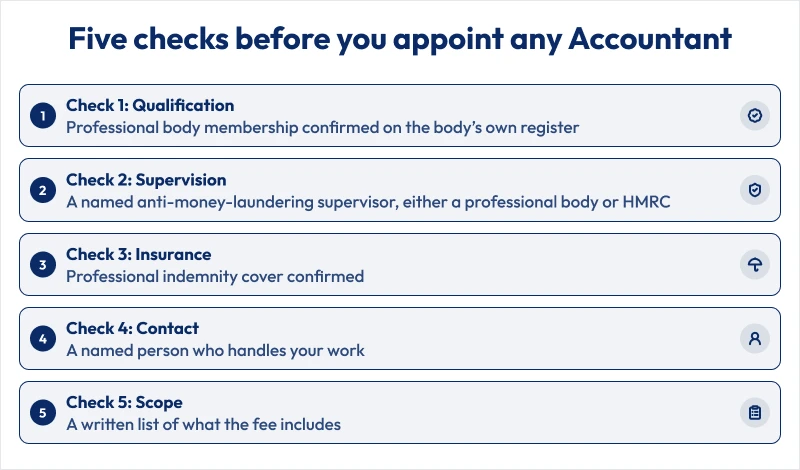
These five checks can help sole traders, partnerships and limited company directors assess an accounting firm before agreeing to its services.
Conclusion
An online accountant can suit sole traders and limited companies that keep digital records and prefer remote communication. A local accountant may be more suitable for businesses that rely on paper records or value regular face-to-face meetings.
However, both types of firm can provide cloud accounting, digital bookkeeping and ongoing business advice. The right choice depends on the services offered, the way you prefer to work and the support your business needs.
Daniel Wolfson & Co works with limited companies across North-west London, offering support online or in person. To discuss the accounting support your business needs, book a consultation or email office@danielwolfson.co.uk.
FAQs
How do I compare two accountant fee proposals if only one includes software?
Add the annual software subscription to the proposal that excludes it. Then compare both yearly totals and check that the software plan supports your invoice volume and number of users.
Should the accounting software subscription be in my company’s name?
Ideally, the business should control its own subscription and invite the accountant to access it. This makes it easier to retain access to financial records if the accountant changes.
Is a fixed monthly fee better than an hourly rate?
A fixed fee can make budgeting easier when the services included are clearly listed. An hourly rate may suit a business that needs occasional support. Ask for an estimate or spending limit before additional work begins.
Can an online accountant meet clients in person?
Some online accountants offer in-person meetings, but this is not included as standard. Confirm whether meetings are available, how often they can take place and whether they involve an extra charge.
When is the best time to change accountants?
Changing after a filing deadline or at the start of a VAT quarter can make the handover easier. However, a business can change accountants at other times too, provided the new firm agrees how to handle work already in progress.
Can a business keep its bookkeeper and appoint an accountant only for year-end work?
Yes, many businesses use a bookkeeper for regular record-keeping and appoint an accountant for annual accounts and tax returns. Both parties should agree who is responsible for reconciling the books and preparing the records for year-end.
About the Author