
If you’re running a business as a sole trader, you may have a range of costs to pay for, from software and office supplies to travel, equipment and professional fees. Some of these can be claimed as allowable expenses, reducing the profit on which you pay tax.
Missing a valid business cost can mean paying more tax than necessary, while claiming a cost incorrectly can lead to questions from HMRC. The challenge is knowing which costs qualify, as the rules can vary depending on the type of expense.
So, what can you claim as a sole trader, and which costs should you avoid claiming? This guide answers that question by covering the main allowable and disallowable expenses, how different costs are treated, and how to report them through Self Assessment.
Key takeaways
- Allowable expenses reduce the taxable profit of a sole trader when they meet HMRC’s rules.
- Sole trader expenses can include costs for travel, equipment, staff, training, stock and professional services.
- Only the business portion of a cost can usually be claimed where an expense has a private element.
- Larger purchases may fall under capital allowances rather than ordinary business expenses.
- You can claim actual allowable expenses or use the £1,000 trading allowance, but not both.
What is an Allowable Business Expense for a Sole Trader?
An allowable business expense is a cost a sole trader can deduct from business income when calculating taxable profit. To qualify, the expense must be incurred wholly and exclusively for the purposes of the trade, unless specific rules apply.
The key consideration is why the expense was incurred, not simply whether it was paid from a business account or relates to the business. If a cost has both business and private purposes, the full amount may not qualify. Where specific rules apply, these must also be considered.
For example, a professional subscription used solely for the trade may qualify in full. If it also provides private benefits, the business element needs to be assessed separately.
These rules apply across many costs a sole trader may incur, including office supplies, home-working expenses, travel, training, marketing and professional fees. The treatment can vary by expense type, so each category needs to be considered under the rules that apply to it.
What Business Expenses can a Sole Trader claim in the UK?
A sole trader can typically claim running costs across several categories, including office and home-working costs, travel, staff, stock, marketing, professional fees and training. Whether a specific cost within one of these categories is allowable still depends on its purpose and any rules HMRC applies to that expense type.
Office, equipment and home-working expenses
Stationery, printing, postage, printer supplies and business software used for the trade can generally be claimed as allowable business expenses. Business telephone and internet costs can also qualify, with any private use excluded.
For home working, HMRC allows two methods: simplified expenses or actual costs. Simplified expenses use a fixed monthly rate based on hours worked from home, while actual costs allow a reasonable business proportion of household costs.
| Hours worked from home each month | Simplified expense |
|---|---|
| 25 to 50 hours | £10 per month |
| 51 to 100 hours | £18 per month |
| 101 hours or more | £26 per month |
The simplified rate covers household costs such as heat, light and power, but not telephone or internet.
Under the actual-cost method, you can claim a reasonable business proportion of costs such as electricity, heating, Council Tax, rent or mortgage interest. Mortgage capital repayments are not allowable. The business proportion should reflect factors such as the rooms used and the amount of time they are used for business.
For instance, if a sole trader uses one of four rooms for work and that room is used for the trade for half of the week, the calculation should take both the proportion of the home used and the business use of that room into account.
Equipment also depends on the accounting method. Under cash basis accounting, qualifying equipment such as computers is generally claimed as an allowable expense rather than through capital allowances. Under traditional accounting, qualifying equipment may instead be dealt with through capital allowances.
For example, a £2,000 computer used in the trade would not automatically be treated as a capital allowance claim. The accounting method and any private use need to be considered first.
Travel and vehicle costs
Business travel is allowable when it’s genuinely for the trade. Ordinary commuting between home and a regular workplace doesn’t count, while journeys to a client’s premises, a temporary site or a supplier do.
HMRC’s simplified mileage rates are an optional method. A sole trader can use them instead of calculating the actual allowable vehicle costs.
The rate for cars and vans changed partway through the current tax year:
| Vehicle | 2025/26 rate (first 10,000 miles) | 2026/27 rate (first 10,000 miles) | Rate above 10,000 miles |
|---|---|---|---|
| Cars and vans | 45p | 55p | 25p |
| Motorcycles | 24p | 24p | 24p |
| Bicycles | 20p | 20p | 20p |
The 2026/27 increase was confirmed by HMRC and is set out on GOV.UK’s mileage and fuel rates page. Once mileage is chosen as the method for a particular vehicle, that method generally needs to continue for that vehicle while it stays in the business.
Hotel stays, train and bus fares, and meals connected to an overnight business trip are also allowable, provided the trip itself is wholly for business purposes.
Staff and subcontractor costs
Salaries, bonuses, employer National Insurance contributions, pension contributions and subcontractor or freelancer fees are all allowable staff costs.
Where a family member is on the payroll, HMRC expects their pay to match what an unrelated person would reasonably be paid for the same role, not a figure set purely to reduce the tax bill. A sole trader running a small catering business who pays her teenage son to help with deliveries would need that rate to reflect an ordinary wage for a delivery assistant, rather than the amount that happens to save the most tax.
Training expenses
Training can qualify when it maintains or updates skills used in the existing trade. Relevant training that keeps those skills current or develops them further can therefore be part of the business costs claimed by a sole trader.
The position changes where the training is intended to establish a separate trade. If a person running an existing photography business pays for advanced photography training, the connection with the existing trade is clear. A course designed to move into an entirely unrelated line of work would generally be treated differently.
Stock and materials
Stock bought for resale and materials used to make products or provide services can generally be included in allowable expenses.
The amount paid during the year is not always the same as the cost recognised when calculating taxable profit. Under traditional accounting, stock remaining at the end of the accounting period needs to be taken into account. This means unsold stock can affect the expense figure used in the profit calculation.
Marketing and advertising
Website hosting and design, paid advertising, business cards and other promotional costs can generally qualify where they are incurred for the trade.
The purpose of the spending still matters. Paying for a meal with a prospective or existing client may support a business relationship, but that does not make it an allowable advertising expense. Client entertainment is generally disallowable for tax purposes.
Financial, legal and professional costs
Accountancy fees, business insurance, professional subscriptions, business bank charges and legal advice relating to the trade can generally be claimed as tax-deductible expenses.
For borrowing costs, it is important to separate the interest from the amount originally borrowed. Qualifying loan interest may be allowable, but repaying the loan itself is not an allowable business expense.
These costs often become more complicated where a payment has both business and private use, or where the payment relates to an asset rather than an everyday business cost. Those differences need to be reflected before the expense is included in the tax calculation.
What expenses a Sole Trader cannot claim?
Disallowable expenses are costs a sole trader cannot deduct when calculating taxable profit. Common examples include personal spending, client entertaining, fines and penalties, ordinary clothing, and private or commuting travel.
- Client entertaining: Lunches, dinners, tickets and hospitality provided for clients or suppliers are generally not allowable, even when intended to win or retain business.
- Fines and penalties: Parking fines, speeding fines and other penalties are not allowable business expenses, even if incurred during a business journey.
- Ordinary clothing: Everyday clothing, such as a suit bought for client meetings, is generally not allowable because it can be worn outside the trade. Uniforms and protective or specialist clothing may qualify when required for the work.
- Private and commuting travel: Travel between home and a regular workplace is ordinary commuting, not business travel, so it is generally disallowable.
- Personal expenses: Costs incurred for private purposes cannot be claimed as sole trader expenses, even when paid from a business bank account.
Where a cost has both business and personal use, the treatment is different. The business portion may be allowable if it can be identified on a reasonable basis.
How are expenses split between Business and Personal use?
Some costs don’t fall cleanly into either category above, because they serve both the business and everyday life at the same time.
Where that happens, HMRC allows a deduction only for the genuinely business portion, calculated on a basis that can be shown if asked, not an estimate made after the fact. The table below shows how this applies to common sole trader expenses.
| Expense | Business-use treatment | What to consider |
|---|---|---|
| Mobile phone | Business-use portion may be allowable | Separate private calls and data from business use, often using itemised bills |
| Home broadband | Business proportion may be allowable | Calculate a reasonable business share based on actual use |
| Car | Mileage rate or actual costs, depending on the method chosen | Keep a mileage log or detailed records of running costs |
| Laptop | Business-use portion may qualify | Consider private use and whether capital allowances apply |
For example, a sole trader buys a £1,500 laptop and uses it 80% for the trade and 20% privately. The £1,200 business proportion may qualify, but because a laptop is a longer-term asset, the accounting basis should be checked before deciding how the deduction is claimed.
The same approach applies to other business and personal expenses, with the calculation depending on the type of cost and how it is used.
What are Capital Allowances and how do they differ from expenses?
Capital allowances provide tax relief on qualifying business assets, such as equipment, machinery and some business vehicles. These are treated differently from ordinary business expenses, which cover the day-to-day costs of running the trade.
A simple way to understand the difference is to compare the cost with the asset it relates to:
- Consumable vs asset: Printer cartridges are used up as part of normal business activity, while the printer itself provides equipment for use over several years. The cartridge is generally a day-to-day expense, while the printer may fall under the capital allowance rules.
- Repair vs improvement: Repairing a piece of equipment to keep it working can be a revenue expense. Replacing it with a substantially improved or upgraded asset can have a different treatment because the spending may be capital in nature.
- Running cost vs purchase: A regular cost such as equipment maintenance may be an ordinary business expense, while buying the equipment itself may be a capital purchase.
The tax relief available for a capital purchase depends on the accounting method, type of asset and capital allowance rules for the relevant tax year. Some assets also have specific rules, so the treatment should be checked before the cost is claimed.
Once the correct treatment has been established, it can be taken into account when calculating the sole trader’s taxable profit.
How do Allowable Expenses affect a Sole Trader’s Trading Profit?
Allowable business expenses reduce the taxable profit reported by a sole trader. The calculation starts with business income and deducts costs that qualify under HMRC rules.
| Calculation | Amount |
|---|---|
| Business turnover | £40,000 |
| Allowable business expenses | £8,000 |
| Taxable trading profit | £32,000 |
The £8,000 deduction means tax is calculated on £32,000 of trading profit rather than the full £40,000 turnover. However, this does not mean the sole trader’s tax bill falls by £8,000. The expense reduces the profit being taxed, not the tax payable by the same amount.
Only costs that qualify as allowable expenses can reduce the profit. Personal or disallowable costs must be excluded, while costs such as capital purchases may need separate treatment under the relevant rules.
If a sole trader does not want to claim individual business expenses, there is another way to calculate the deduction in some circumstances. This is where the £1,000 trading allowance may apply.
Should a Sole Trader use the £1,000 Trading Allowance or claim Actual Expenses?
If your eligible trading income is £1,000 or less, the trading allowance may cover it in full. That may mean no Income Tax is due on that trading income, depending on the circumstances and eligibility rules.
If your income is above £1,000, it’s worth comparing the flat £1,000 allowance against your actual allowable expenses before deciding how to calculate your profit.
- Claiming actual expenses means totalling up everything you’ve genuinely spent and deducting that figure from turnover. This tends to produce a bigger deduction once your costs regularly exceed £1,000 a year.
- Claiming the trading allowance means deducting a flat £1,000 instead of your real costs, regardless of what you actually spent. It’s simpler, but you can’t use it alongside actual expenses for the same trade. It’s one or the other.
The choice should therefore be based on your actual figures rather than simply choosing the option that sounds easier. The key differences are:
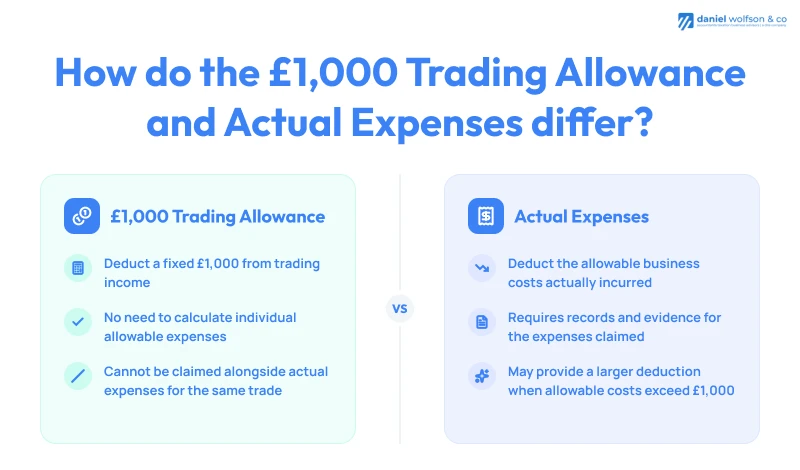
Comparing the two methods against the business’s actual figures can help determine which deduction is more suitable. Whichever method is used, the figures must then be reported correctly through Self Assessment.
How does a Sole Trader report expenses through Self Assessment?
Expenses are reported in the self-employment section of the Self Assessment return. The form and level of detail required depend on the information HMRC asks for in the relevant tax return and guidance notes.
Sole traders should check whether the short or full self-employment pages apply before filing, based on their turnover and circumstances for that tax year.
The practical sequence stays the same regardless of which pages apply:
- Keep records of income and expenses through the year.
- Check which version of the self-employment pages applies, based on the current HMRC guidance for that tax year.
- Submit the online Self Assessment return by 31 January following the end of the tax year. Any tax due is also usually payable by 31 January, with a second payment on account due on 31 July where the rules apply.
What records does HMRC expect a Sole Trader to keep?
Your records need to support the figures and claims on your return, not just exist somewhere in case they’re needed:
- Receipts, invoices, and bank statements for every claimed cost.
- Digital copies can be kept where appropriate, provided the records remain accurate and usable as evidence for the figures reported.
- Business records should generally be kept for at least five years after the 31 January submission deadline for the relevant tax year. Different rules can apply in certain circumstances, such as very late returns.
- Evidence organised well enough that you could reconstruct and justify a figure if HMRC asked about it later.
If HMRC can’t establish that a cost was allowable and properly incurred, it can disallow the deduction and adjust the tax calculation.
Does Making Tax Digital change how expenses are claimed?
Making Tax Digital for Income Tax changes how eligible sole traders keep records and report income and expenses. It doesn’t change the underlying rules for deciding whether an expense is allowable.
Digital record-keeping and receipt evidence answer two different questions. Making Tax Digital governs how transactions are recorded and reported through the year; it doesn’t disqualify a paper receipt as proof that a cost was genuinely incurred.
Eligibility and the start date depend on qualifying income and the thresholds in force for the relevant tax year, so checking the current position is more reliable than assuming a fixed figure applies indefinitely.
A self-employed physiotherapist who also lets out a flat, for example, would need to count both sources of income together against the relevant threshold, not just the clinic earnings on their own.
How can Daniel Wolfson & Co help with Sole Trader accounting?
Managing business expenses is not only about knowing which costs are allowable. Sole traders also need to keep appropriate records, separate business and personal costs, account for asset purchases correctly and report the figures through Self Assessment.
Daniel Wolfson & Co’s sole trader accounting services can support sole traders with accounts, tax, expense management, Self Assessment returns and tax planning. The firm also provides bookkeeping support for sole traders who need help maintaining organised financial records.
If you are also unsure whether you’re claiming the right business expenses, keeping the right records or choosing between actual expenses and the trading allowance, book a consultation now or email us at office@danielwolfson.co.uk .
Frequently asked questions
Can a sole trader claim for equipment bought before the business started?
Yes, some pre-trading costs can be treated as if incurred on the day trading began, though specific rules and limits apply depending on the type of cost and how long before start-up it was bought.
Does claiming allowable expenses increase the chance of an HMRC enquiry?
Claiming expenses genuinely due doesn’t itself raise the risk. What tends to attract attention is claims that look disproportionate to the size or type of the business, or expenses that aren’t properly evidenced.
Can a sole trader reclaim VAT on expenses if they’re not VAT-registered?
No, VAT recovery only applies through a VAT return if the business is VAT-registered. A non-VAT-registered sole trader instead includes the gross cost, VAT included, within their allowable expense claim for Income Tax purposes.
What happens if an expense is claimed by mistake?
An honest error can often be corrected by amending the tax return within the permitted amendment window. Once that window has passed, the sole trader would need to contact HMRC directly using the correction process that applies to that tax year.
Can a sole trader claim expenses if they also have a PAYE job?
Yes, the two are treated separately. Employment income taxed through PAYE doesn’t affect what can be claimed against self-employed trading income, provided the expenses relate to the self-employed business itself.
About the Author