Paying less tax legally is possible when you understand available deductions. The UK tax system offers numerous tax deductions and reliefs for savvy taxpayers. Many individuals and businesses overpay thousands in tax annually simply because they don’t know which expenses are tax deductible or what they can legitimately claim back on tax.
This comprehensive guide covers the key UK tax deductions, allowances and reliefs available for the 2026/27 tax year. You’ll discover practical strategies to maximise your Self Assessment tax savings, understand allowable business expenses, and learn how to reduce your UK tax bill through legitimate tax planning.
Understanding UK Tax Allowances for 2026/27
Personal Allowance Explained
The standard personal allowance which is part of your tax allowances in the UK stands at £12,570 for 2026/27. You earn this amount tax-free before paying any income tax. However, this allowance decreases if your income exceeds £100,000.
Planning your income strategically helps maximise this valuable allowance and is one of the key tax breaks available to all UK taxpayers. For England, Wales and Northern Ireland, taxable income above the Personal Allowance is generally taxed at 20% within the basic-rate band, with higher and additional rates applying above that.
For incomes between £100,000 and £125,140, the personal allowance is tapered away at a rate of £1 lost for every £2 of adjusted net income over £100,000, creating an effective marginal rate spike. Consider timing bonuses, pension contributions, and Gift Aid donations to reduce adjusted net income and preserve the allowance.
Income Tax Bands and Rates
Understanding which tax band you fall into is important for planning. For 2026/27, the standard Personal Allowance remains £12,570. For England, Wales and Northern Ireland, the basic rate is 20%, the higher rate is 40%, and the additional rate is 45%.
| Income Range after allowances | Tax Rate | Tax Band |
|---|---|---|
| £0 – £12,570 | 0% | Personal Allowance |
| £12,571 – £50,270 | 20% | Basic Rate |
| £50,271 – £125,140 | 40% | Higher Rate |
| Over £125,140 | 45% | Additional Rate |
Source: Income Tax Rates and Personal Allowances
Note: Different thresholds apply in Scotland for non-savings, non-dividend income, though UK-wide rates generally apply to savings and dividends; check current Scottish bands if resident in Scotland. Dividend and savings income have separate allowances and rates, so plan across income types rather than just salary.
Need help optimising your tax allowances and filing accurately? Our Self Assessment tax return accountants can help you claim every allowance you’re entitled to.
Marriage Allowance Benefits
Married couples or civil partners can transfer part of their personal allowance. This transfer can save up to £252 annually in tax. It’s ideal when one partner earns less than the personal allowance.
Eligibility requires the transferor to be a non-taxpayer and the recipient to be a basic-rate taxpayer; backdating claims is possible for up to four tax years, potentially increasing total savings.
Capital Gains Tax Annual Exempt Amount
Each individual receives an annual capital gains tax annual exempt amount. For 2026/27, this is £3,000 for individuals. The annual exempt amount reduces the amount of taxable gains; it does not mean that you can sell assets worth £3,000 without tax in every circumstance.
Spouses and civil partners can transfer assets between themselves on a no-gain/no-loss basis to use two CGT exemptions and potentially lower rate bands before a disposal.
Timing disposals across tax years can help manage gains and make use of available annual exempt amounts. Remember that different CGT rates can apply depending on the type of asset and your tax position, and residential property disposals can have specific reporting and payment deadlines.
Self-Assessment Expenses You Can Claim
Understanding what tax deductions are is essential for reducing your tax bill. For self-employed individuals, allowable business expenses are costs that can be deducted when calculating taxable business profits, provided they meet HMRC’s rules. This section covers common tax deductions available to self-employed individuals and businesses.
Ensure records are accurate, wholly and exclusively for business, and supported by receipts or digital copies to remain compliant. Remember that capital items may be claimed via capital allowances or the Annual Investment Allowance rather than as day-to-day expenses.
Office Equipment and Supplies
Business-related purchases qualify as allowable business expenses for sole traders. Computers, desks, stationery and office furniture may be claimable where they are used for the business and meet HMRC’s rules. These costs can reduce your taxable income when claimed correctly and are essential tax-deductible expenses in the UK.
Where items have dual personal and business use, claim only the business proportion. Larger equipment may qualify for capital allowances, including the Annual Investment Allowance, depending on the circumstances.
Travel and Transport Expenses
Business travel costs can significantly reduce your tax bill. Fuel costs, public transport fares and parking fees for qualifying business journeys are allowable. Hotel stays and certain meals during qualifying business trips may also qualify.
Ordinary commuting to a regular workplace is not allowable; only travel to temporary workplaces or for business purposes qualifies. Congestion charges, tolls, and necessary business taxis are allowable, but fines and penalties are not.
Mileage Claims
From the 2026/27 tax year, HMRC’s approved mileage rate for cars and vans is 55p per mile for the first 10,000 business miles and 25p per mile thereafter. Maintain a detailed mileage log recording every business trip.
Choose either simplified mileage rates or actual running costs (plus capital allowances where applicable); do not mix methods for the same vehicle in the same period. Record the date, purpose, start/end locations, and miles for each journey to substantiate claims.
| Vehicle Type | First 10,000 Miles | Additional Miles |
|---|---|---|
| Cars and Vans | 55p per mile | 25p per mile |
| Motorcycles | 24p per mile | 24p per mile |
| Bicycles | 20p per mile | 20p per mile |
If claiming approved mileage rates for a vehicle, you generally cannot also claim the actual fuel or other running costs for the same vehicle. Electric cars can also use the approved mileage rates.
Home Office Expenses
Working from home lets self-employed people claim a fair share of household costs as tax-deductible business expenses. Claim a proportion of rent or mortgage interest, utilities, internet and phone, plus heating, based on genuine business use. Keep clear records and apply a consistent, reasonable split using rooms used and/or time worked to evidence the calculation.
Alternatively, use HMRC’s simplified flat-rate method if tracking actual costs is complex. The simplified method can be used by eligible sole traders and partnerships, but not by limited companies. Evidence apportionment with reasonable, consistent methods and avoid creating unnecessary business rates or CGT implications through exclusive business use.
Simplified Expenses Methods
HMRC provides flat rates based on hours worked from home.
| Hours Worked from Home | Monthly Allowance |
|---|---|
| 25-50 hours | £10 |
| 51-100 hours | £18 |
| 101+ hours | £26 |
These simplified home-working rates remain £10, £18 and £26 per month. They are available to eligible self-employed individuals using the simplified expenses method.
Maintain mixed use of rooms to avoid business rates and potential CGT restriction on Private Residence Relief from exclusive business use. For the official rules, see HMRC’s simplified expenses guidance.
Marketing and Advertising Costs
Qualifying advertising and marketing expenses incurred wholly and exclusively for the business can generally be allowable, including website development, domain/hosting, online ads, social media ads, print ads, design, copywriting, landing pages, PPC, directory listings, business cards, mailshots, and website maintenance.
Promotional merchandise and free samples used to win or retain customers are allowable in qualifying circumstances, as are relevant trade journals and professional memberships tied to the business. Keep clear records linking each spend to promotion and exclude any personal element.
Entertainment of clients or suppliers and event hospitality are not allowable as marketing; exclude them from claims. Apply the “wholly and exclusively” test and consider capital treatment if a cost creates an enduring asset.
Training and Professional Development
Business-related courses and certifications are claimable expenses. Training that improves your existing business skills qualifies. Professional subscriptions and memberships are also allowable where they meet HMRC’s conditions.
Training to start a completely new trade is usually not allowable, whereas training that updates or improves skills used in your existing trade may qualify.
Insurance Premiums
Business insurance premiums can be allowable business expenses where they relate to the trade, including public liability insurance, professional indemnity insurance and employer’s liability insurance.
Vehicle insurance attributable to business use can be apportioned; private elements are not allowable. Key person insurance may have different treatment depending on policy structure and beneficiaries, so check the specific circumstances before claiming.
Legal and Professional Fees
Accountant fees for preparing tax returns are allowable expenses. Bookkeeping services, financial advice fees and legal fees for business contracts also qualify where they relate to the business.
Legal costs relating to acquiring property or capital assets are capital in nature and not deductible as revenue expenses. Debt collection fees and compliance advice linked to the trade are generally allowable.
Phone and Internet Expenses
Business phone and internet costs are legitimate allowable expenses. A separate business line allows you to claim qualifying business costs in full. Mixed personal and business use requires proportional claiming.
For a sole trader, a dedicated business mobile used only for business can typically be claimed in full. Landline and broadband with mixed use should be split on a fair and reasonable basis, documented in working papers.
Bank Charges and Interest
Business bank account charges are fully tax-deductible expenses where they relate to the business. Credit card charges for business purchases and interest on business loans also qualify subject to the relevant tax rules.
Interest on personal borrowing used for business may be allowable if the funds are introduced into the business and properly evidenced. Overdraft fees and payment processing charges related to sales are generally allowable.
Stock and Raw Materials
Items purchased to create products or services are deductible. Raw materials, ingredients for your business and goods bought specifically for resale are fully allowable.
Opening and closing stock must be accounted for correctly to calculate cost of sales. Write-downs for obsolete or damaged stock may be allowable when evidenced.
Staff Costs and Wages
Employee salaries and wages are major allowable expenses. Bonuses, commissions, employer’s National Insurance and pension contributions for staff reduce your tax liability.
Use PAYE correctly and submit Real Time Information on time to avoid penalties. Employer pension contributions must meet scheme rules; consider salary sacrifice arrangements where appropriate.
Subcontractor and Freelancer Fees
Payments to subcontractors are legitimate business expenses. Ensure you follow Construction Industry Scheme (CIS) rules when paying subcontractors.
Verify subcontractor status and apply the correct CIS deduction rate; keep monthly CIS returns and statements. For IR35/off-payroll working, assess status to ensure labour is treated correctly for tax.
Learn more about how IR35 rules impact contractors and companies in our detailed IR35 compliance guide.
Tax-Saving Strategies for 2026/27
Pension Contributions for Tax Relief
Contributing to pensions can reduce your taxable income and represents an important opportunity for income tax planning. Personal pension contributions receive tax relief subject to the applicable rules and limits. The standard annual allowance for 2026/27 is £60,000.
The £60,000 Annual Allowance may be reduced by tapering for high earners, where threshold and adjusted income limits are exceeded. For 2026/27, the threshold income limit is £200,000 and the adjusted income limit is £260,000 for the tapered annual allowance rules. Carry forward of unused pension allowance from the previous three tax years can boost allowable contributions if eligible.
Relief is given via relief-at-source for personal pensions (basic rate added by the provider) with higher/additional rate relief claimed through Self Assessment, while some workplace schemes use net pay arrangements.
How Pension Tax Relief Works
- Basic-rate taxpayers: £1,000 contribution cost only £800
- Higher-rate taxpayers: £1,000 contribution cost only £600
- Additional-rate taxpayers: £1,000 contribution cost only £550
These examples illustrate the effective cost after tax relief; the exact benefit depends on your income, pension arrangement and tax position.
Ensure contributions do not exceed 100% of relevant UK earnings for personal contributions, subject to the applicable rules, and monitor the Money Purchase Annual Allowance if triggered by flexible access to pensions. Consider salary sacrifice to exchange gross pay for employer pension contributions, potentially saving employee and employer National Insurance.
ISA Contributions for Tax-Free Growth
Individual Savings Accounts (ISA) offer tax-free investment growth. You can contribute up to £20,000 during the 2026/27 tax year into ISAs. Interest, dividends and capital gains inside ISAs are tax-free.
The overall ISA allowance can be split across Cash, Stocks & Shares, Innovative Finance, and Lifetime ISA, subject to product limits and eligibility.
Lifetime ISAs offer a 25% government bonus on up to £4,000 per year for first-time home purchase or retirement from age 60, subject to withdrawal rules and penalties.
The overall ISA subscription limit remains £20,000 for 2026/27. Planned Cash ISA changes take effect from 6 April 2027, so they should not be presented as current 2026/27 rules.
Annual Investment Allowance (AIA)
As per HMRC’s AIA rules, businesses can claim 100% tax relief on qualifying plant and machinery up to the £1 million AIA limit, subject to the relevant rules. Equipment, machinery, and certain vehicles may qualify.
The £1,000,000 AIA limit is now a permanent level, giving businesses greater certainty when planning qualifying investments.
AIA generally excludes cars; consider first-year allowances where applicable, especially for qualifying low-emission assets.
Time purchases near year-end carefully to align with accounting periods and maximise relief in the desired year.
Capital Allowances on Business Assets
Assets not covered by the Annual Investment Allowance (AIA) receive Writing Down Allowances. Zero-emission vehicles may qualify for 100% first-year allowances where the relevant conditions are met.
The main rate pool typically attracts an 18% writing down allowance, while the special rate pool attracts 6%.
Keep detailed fixed asset registers and claim enhanced allowances where criteria are met, such as the structures and buildings allowance for qualifying construction costs.
Enterprise Investment Schemes (EIS)
EIS investments provide up to 30% income tax relief on qualifying subscriptions up to £1,000,000, rising to £2,000,000 where the amount over £1,000,000 is invested in knowledge-intensive companies.
CGT exemption on disposal applies if shares are held for at least three years and the investor obtained EIS income tax relief that has not been withdrawn.
CGT deferral lets gains from other assets be deferred by reinvesting into EIS shares, typically for gains made up to three years before or one year after the EIS subscription.
Loss relief can be claimed against income or capital gains for a loss-making EIS investment, after deducting any EIS income tax relief already received.
Venture Capital Trusts (VCTs)
VCT investments offer 30% income tax relief on new share subscriptions. The maximum annual investment eligible for relief is £200,000 per tax year, limited to the investor’s actual income tax liability for that year.
Dividends from VCTs are tax-free for investors and generally do not need to be reported on a tax return.
To retain the 30% income tax relief, VCT shares must typically be held for at least five years; disposing earlier can trigger a clawback of relief.
Gains on disposal of qualifying VCT shares are generally exempt from Capital Gains Tax, independent of the five-year income tax relief holding condition.
Gift Aid and Charitable Donations
Donating via Gift Aid lets charities reclaim 25p for every £1 donated, provided the donor pays at least that much UK Income Tax and/or CGT for the year.
Higher and additional rate taxpayers can claim extra relief through Self Assessment by extending the basic and higher rate bands by the grossed-up donation (treating £1 as £1.25), giving relief equal to the difference between their marginal rate and 20%.
Gift Aid can be carried back by election so a donation made after 5 April can be treated as made in the previous tax year if included on the original return submitted by the filing deadline.
If insufficient tax is paid to cover the charity’s reclaim, the donor may need to pay the shortfall.
Tax Planning for Limited Companies
Salary vs Dividends Strategy
Company directors can optimise income by combining a modest salary with dividends, since dividends are taxed at lower rates than employment income and are not subject to employee NICs.
Pay yourself a salary up to the tax-free amount to keep your state pension rights while paying little or no National Insurance, then take extra income as dividends from your company’s profits after tax.
Plan to use both your Personal Allowance and Dividend Allowance. For 2026/27, the Dividend Allowance is £500 and dividend tax rates are 10.75% for basic-rate taxpayers, 35.75% for higher-rate taxpayers and 39.35% for additional-rate taxpayers.
The best balance between salary and dividends depends on your total income and personal circumstances, so check it annually to stay tax-efficient and avoid paying more than necessary.
Employer Pension Contributions
Employer pension contributions can usually be deducted from corporation tax if they are a genuine business expense and part of a reasonable remuneration policy.
These contributions do not attract employer or employee National Insurance, so contributing to a pension instead of paying salary can create significant National Insurance savings.
Contributions must stay within pension allowance limits, including the annual allowance (typically £60,000, though this can vary with income and carry-forward rules) and any scheme restrictions. Very large one-off payments may need clear justification regarding timing and overall remuneration.
Salary sacrifice arrangements, where employees exchange part of their salary or bonus for employer pension contributions, can reduce Income Tax and National Insurance for employees and National Insurance for employers, increasing the overall benefit for everyone.
The way personal tax relief works depends on the pension scheme type, but employer contributions themselves are not taxed as a benefit for employees.
VAT Schemes for Tax Efficiency
The Flat Rate Scheme simplifies VAT by applying a fixed percentage to VAT-inclusive turnover, reducing admin but limiting input VAT recovery except certain capital assets; limited-cost traders use 16.5%.
The Cash Accounting Scheme improves cash flow by paying VAT only when customers pay and reclaiming when suppliers are paid, aligning VAT with receipts and reducing bad-debt risk.
Choose based on turnover, input VAT, margins, and payment terms to fit the business model.
VAT schemes are not direct tax deductions, so they should be considered as part of wider business tax and cash-flow planning rather than presented as a way to reduce Income Tax.
Record Keeping for Self-Assessment Success
Essential Documentation Requirements
Proper records are essential to claim tax deductions confidently. Keep receipts, invoices, and bank statements for the period required by HMRC for your circumstances. Digital records are acceptable if stored securely and accessibly.
For Self Assessment, record-keeping requirements vary depending on whether you are self-employed, a landlord or filing for another reason. Check the current HMRC requirements rather than applying one retention period to every taxpayer.
Best Practices for Expense Tracking
Use accounting software to track expenses throughout the year. Separate business and personal bank accounts for clarity. Photograph receipts immediately to prevent loss or fading.
Mileage Log Requirements
Maintain detailed records of all business journeys undertaken. Note the date, start point, destination and purpose. Record actual miles travelled for accurate mileage claims.
Common Tax Filing Mistakes to Avoid
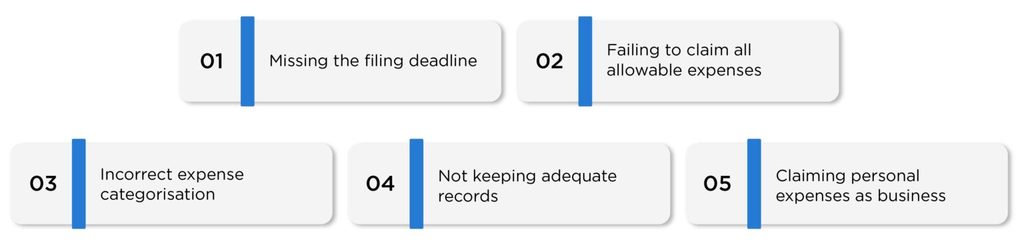
Missing the Filing Deadline
The online Self Assessment filing deadline is 31 January; paper returns are due by 31 October, and tax due must be paid by 31 January or interest and late payment penalties apply.
For the 2025/26 tax return, the paper filing deadline was 31 October 2026 and the online filing and payment deadline is 31 January 2027. The 2026/27 tax return will generally be filed after the tax year ends, with the online filing and payment deadline falling on 31 January 2028.
An automatic £100 late filing penalty applies immediately after the filing deadline, with additional penalties at 3, 6, and 12 months late.
Payments on account are due on 31 January and 31 July when required, typically based on the prior year’s liability above HMRC’s threshold; budgeting for both dates helps avoid penalties and interest.
Submitting by 30 December allows collection through PAYE where eligible; otherwise, pay by 31 January to avoid late payment charges.
File Your Self Assessment: HMRC Self Assessment Online
Failing to Claim Allowable Expenses
Many taxpayers miss legitimate expenses they could claim. These missed tax deductions can cost hundreds or thousands of pounds annually. Review all business expenditure carefully before filing returns. Don’t leave money on the table through oversight.
Ensure expenses are wholly and exclusively for business and apportion any mixed-use cost reasonably. Cross-check bank statements, receipts, and subscription lists to capture recurring software, payment processing, and small tools often overlooked.
Incorrect Expense Categorisation
Misclassifying expenses can trigger HMRC enquiries and investigations. Understand which expenses belong in which categories clearly. Seek professional advice if uncertain about categorisation.
Choose consistently between cash basis and traditional (accruals) accounting, as categorisation and timing differ. Capital items should generally be treated under capital allowances rather than day-to-day expenses.
Not Keeping Adequate Records
Poor record-keeping makes claiming expenses extremely difficult. HMRC can disallow expenses without supporting documentation. Implement good record-keeping systems from day one.
Keep records for the period required by HMRC for your particular tax return and business circumstances, rather than applying a single retention period to every taxpayer.
Use cloud accounting with bank feeds and mileage/home-working logs to automate evidence collection.
Claiming Personal Expenses as Business
Never claim personal expenses as business deductions. HMRC takes a dim view of this practice. It can result in investigations, penalties and prosecution.
Client entertainment and most fines are not allowable even if paid via the business. Document apportionments for phone, internet, vehicle use, and home office to prevent accidental over-claiming.
| Expense Category | Examples | Simplified Option? | Official Guidance |
|---|---|---|---|
| Office Cost | Equipment, supplies, furniture | No | HMRC Link |
| Travel | Mileage, fares, accommodation | Yes | HMRC Link |
| Home Office | Utilities, rent, internet | Yes | HMRC Link |
| Marketing | Advertising, website, promotions | No | HMRC Link |
| Training | Courses, certifications, books | No | HMRC Link |
Tax-Saving Checklist for 2026/27
- Maximise the £12,570 personal allowance; consider income shifting within couples.
- Use Marriage Allowance to transfer up to £1,260 of Personal Allowance, potentially saving up to £252 in tax for an eligible couple.
- Contribute to pensions up to £60,000; check the tapered annual allowance rules if your income is high.
- Use the full £20,000 ISA limit across permitted ISA types.
- Claim only wholly and exclusively business expenses, with evidence retained.
- Keep complete records and receipts to substantiate all claims.
- Use simplified home-working expenses if a sole trader and eligible.
- For 2026/27, use the updated 55p-per-mile rate for the first 10,000 business miles when the approved mileage method applies to cars and vans.
- Make Gift Aid donations and claim higher/additional-rate relief where due.
- Use the £3,000 CGT annual exempt amount.
- Time disposals across tax years to optimise CGT bands and allowances.
- Review salary vs dividends using the 2026/27 £500 Dividend Allowance and the applicable dividend tax rates.
- Claim Annual Investment Allowance on qualifying plant and machinery.
- Consider EIS/VCT for 30% income tax relief, subject to limits and holding rules.
- For 2025/26 Self Assessment returns, remember the 31 January 2027 online filing and payment deadline.
Inheritance Tax Planning Considerations
Annual Gift Allowance
You can give away £3,000 per year tax-free; if unused, it can be carried forward one tax year and must be used after the current year’s £3,000, plus small gifts of £250 per person are also exempt but cannot be combined with other exemptions for the same recipient in the same tax year.
Seven-Year Rule
Gifts made more than seven years before death are tax-free; if death occurs between 3 and 7 years, taper relief may reduce the tax due on chargeable gifts, noting that potentially exempt transfers become chargeable only if death occurs within seven years.
Residence Nil-Rate Band
Passing a qualifying home to direct descendants increases the Inheritance Tax (IHT) threshold through the residence nil-rate band, which is £175,000 per person and transferable to a spouse or civil partner. The residence nil-rate band tapers by £1 for every £2 an estate exceeds £2 million, with downsizing provisions potentially preserving the relief.
For 2026/27, the main nil-rate band remains £325,000 and the residence nil-rate band remains £175,000. This means qualifying individuals may have up to £500,000 of combined nil-rate and residence nil-rate bands, with a qualifying surviving spouse or civil partner potentially benefiting from transferable allowances.
When to Seek Professional Tax Advice
Complex Income Sources
Seek self-assessment tax advice if you earn from multiple sources such as freelance work, property rental, investments, or overseas income. A tax adviser can help you correctly report and optimise deductions.
Capital Gains or Asset Sales
When you sell shares, property, or other valuable assets, the capital gains calculation can be tricky. Professional advice ensures compliance and helps reduce unnecessary liabilities.
Change in Employment or Residency
If you move abroad, become self-employed, or change your tax residency, expert guidance ensures you meet the latest reporting requirements.
Uncertain Deductions and Allowances
When unsure about eligibility for reliefs, expenses, or allowances, an adviser can clarify rules and help you avoid penalties.
HMRC Queries or Investigations
If you receive a notice from HMRC regarding your tax return, seeking professional assistance can help resolve disputes promptly and accurately.
Conclusion
Understanding UK tax deductions, allowable expenses, allowances and reliefs can help reduce your tax bill when used correctly. The 2026/27 tax year offers opportunities for tax planning through legitimate deductions, pension contributions, ISA savings, capital allowances and other available reliefs.
Don’t leave money on the table through lack of knowledge. Professional advice often saves far more than it cost. Review your income, expenses and available allowances before completing your Self Assessment return.
Frequently Asked Questions
Which expenses are eligible tax deductions for Self Assessment in 2026/27?
Self-employed individuals can generally claim allowable business expenses that are incurred wholly and exclusively for the purposes of their business. Common examples include office costs, business travel, professional fees, insurance, marketing, phone and internet costs, business bank charges, stock, staff costs and qualifying training. Personal expenses cannot be claimed, and mixed-use costs should be apportioned appropriately.
What can I claim back on tax as an employee or self-employed person in 2026/27?
What you can claim depends on your employment and tax circumstances. Self-employed people can claim qualifying business expenses when calculating taxable profits. Employees may be able to claim certain unreimbursed employment expenses, such as qualifying business travel or professional fees, where HMRC’s conditions are met.
What are the most common UK tax deductions people overlook?
Commonly overlooked deductions include professional subscriptions, business insurance, software subscriptions, business phone and internet costs, qualifying training, mileage, home-working costs and professional fees. Keeping accurate records throughout the year makes it easier to identify all eligible expenses before filing your Self Assessment tax return.
How can I legally save Income Tax in the UK?
You can reduce your tax liability by using legitimate allowances, reliefs and deductions available to you. Depending on your circumstances, this may include claiming allowable business expenses, making pension contributions, using your ISA allowance, making eligible Gift Aid donations and planning the timing of income or gains. Tax planning should always follow HMRC rules.
What’s the difference between tax deductions, tax credits, and tax allowances?
Tax deductions, allowances and tax credits work differently. A tax deduction or allowable expense can reduce the income or profits on which you are taxed. A tax allowance, such as the Personal Allowance, can provide an amount of income that is not subject to Income Tax. Tax credits are separate forms of tax support that can reduce a tax bill or provide financial support where eligibility requirements are met.
Can professional subscriptions and memberships reduce my tax bill?
Yes, certain professional subscriptions and memberships can be claimed where they are relevant to your work or business and meet HMRC’s conditions. For example, a self-employed professional may be able to claim the cost of an eligible professional body membership. Keep evidence of the subscription and check that the organisation and expense qualify before claiming.
Which tax deductions apply to landlords in the UK?
Landlords may be able to claim certain allowable expenses connected with letting property, such as letting-agent fees, insurance, repairs and maintenance, and some professional fees. However, residential landlords have specific rules for finance costs and cannot simply deduct all mortgage interest from rental income. The tax treatment can also differ for furnished holiday lets and other property businesses, so check the rules that apply to your circumstances.
How do I claim tax deductions on my Self Assessment tax return?
Keep records of your income and allowable expenses throughout the tax year. When completing your Self Assessment return, enter the relevant business or employment expenses in the appropriate sections. Keep invoices, receipts, bank statements and other supporting records in case HMRC asks you to substantiate your claims.
What tax deductions can self-employed people claim in 2026/27?
Self-employed people may be able to claim allowable expenses such as office costs, business travel, mileage, qualifying home-working costs, insurance, professional fees, marketing, phone and internet costs, bank charges, stock, staff costs and subcontractor fees. The expense must meet HMRC’s rules, and personal expenditure cannot be claimed as a business expense.
What tax changes apply to UK taxpayers in 2026/27?
For 2026/27, the standard Personal Allowance remains £12,570 and the basic, higher and additional Income Tax rates for England, Wales and Northern Ireland remain 20%, 40% and 45%. The Capital Gains Tax annual exempt amount is £3,000, while the ISA subscription limit remains £20,000. Dividend tax rates for 2026/27 are 10.75%, 35.75% and 39.35%, depending on the taxpayer’s applicable rate.
What accounting tools can help track deductible expenses?
Cloud accounting software can help you record income and expenses, categorise transactions, reconcile bank accounts and keep digital records throughout the year. Using accounting software can make it easier to identify potential allowable expenses and prepare information for your Self Assessment tax return. However, the software does not determine whether an expense is tax-deductible in every circumstance, so check HMRC’s rules or seek professional advice where necessary.
About the Author