Working in a partnership offers great potential for growth, but it also brings far more complexity than running a business alone. Unlike sole traders, partnerships must handle shared finances, profit splits, individual partner accounts, and detailed compliance requirements all of which demand accurate and coordinated financial management.
That’s where partnership accounting services become essential. They ensure accuracy in every transaction, maintain full compliance with HMRC, and build trust among partners by keeping financial information transparent and reliable. With expert support, you can focus on running your business while being confident that every figure adds up exactly as it should.
Here’s how professional partnership accounting services give you clarity, compliance, and confidence. From splitting profits accurately to completing all HMRC paperwork on time, expert support builds a strong financial foundation for your partnership.
Key Takeaways
- What partnership accounting is and how it works?
- Why partnerships have more complex finances than sole traders?
- The different types of partnerships and their accounting needs.
- Key parts of partnership accounts and how they’re prepared.
- How accountants help ensure accuracy, compliance and trust?
- The step‑by‑step process of preparing partnership accounts.
- Filing rules for partnerships and LLPs with HMRC and Companies House.
- Why using professional accounting services prevents errors and disputes?
Note : This article has been updated and republished on 07-April-2026 to include the latest information about Partnership Accounting Services.
What is Partnership Accounting?
Partnership accounting is the structured system for recording, reporting, and allocating a UK partnership’s financial activity. It ensures that profits and losses are shared exactly as set out in the partnership agreement, with separate tracking of each partner’s capital, drawings, and final profit distribution.
In the UK, a partnership is “the relation which subsists between persons carrying on a business in common with a view of profit” as per the Partnership Act 1890, and most partnerships are tax‑transparent: the partnership files a Partnership Tax Return (SA800), while each partner reports their share via Self Assessment
Understanding partnership in accounting is your first and most important step.
Why it’s different from other businesses:
- Sole trader: One owner; no partner allocations; the individual reports all profit directly on Self Assessment without a partnership return.
- Limited companies: A separate legal entity; owners are shareholders, and value is usually extracted via salaries/dividends; company accounts and Corporation Tax apply rather than partner appropriations.
- Partnership (general/limited): The business keeps full books plus separate partner accounts; profits are allocated per the agreement and reported by partners personally; the partnership submits SA800 for HMRC cross‑reference.
SA800 Filing Deadlines – 2025/26
| Filing Method | Deadline | Late Penalty |
|---|---|---|
| Online | 31 January 2026 | Interest on unpaid tax |
| Paper | 31 October 2025 | £100 per partner automatically |
Tip: Always file online – it gives you an extra 3 months and immediate confirmation from HMRC.
- LLPs (Limited Liability Partnerships)
An LLP is a separate legal entity with limited liability for all its members.
Key obligations include:
- Must file statutory accounts publicly at Companies House
- Accounts must be filed within 9 months of the financial year-end
- Late filing penalties start at £150 for accounts up to one month late – rising significantly the longer accounts remain overdue
- Must meet additional reporting requirements compared to general partnerships
- Members are generally taxed individually on their profit shares – the LLP itself does not pay Corporation Tax in typical trading scenarios
Important Exception: An LLP not carrying on a business with a view to profit – or one being wound up by court order – may be subject to Corporation Tax. Seek professional advice if your LLP’s circumstances change.
Since partners pay tax individually on their share of profits, the main job of good partnership accountants is to calculate each partner’s exact taxable profit.
Partner Income Tax Rates – 2025/26
| Taxable Income | Tax Rate | Band Name |
| Up to £12,570 | 0% | Personal Allowance |
| £12,571 – £50,270 | 20% | Basic Rate |
| £50,271 – £125,140 | 40% | Higher Rate |
| Above £125,140 | 45% | Additional Rate |
Each partner is taxed individually on their own profit share. The partnership itself pays no income tax.
National Insurance Contributions (NIC) for Partners – 2025/26
Partners are treated as self-employed for NIC purposes and must pay:
| NIC Class | Rate | On Which Profits |
| Class 4 | 6% | Profits between £12,570 – £50,270 |
| Class 4 | 2% | Profits above £50,270 |
| Class 2 | £3.50/week | Voluntary — protects State Pension |
Class 2 NIC is now voluntary for most partners (from April 2024). However, paying it voluntarily maintains your entitlement to State Pension and certain benefits – strongly recommended if profits are below £6,845.
Important: Tax Year Basis Reform (From April 2024)
From April 2024, UK partnerships moved from the Current Year Basis to a Tax Year Basis of assessment. This means partner profits are now taxed in the year they arise – regardless of the partnership’s accounting period end date.
Who is affected?
- Partnerships with a year-end other than 31 March or 5 April are most impacted
- Partners may need to file tax returns with provisional figures each year
- Transitional adjustments from earlier years may still be spreading into current returns
- If your partnership has a non-standard year-end, seek professional advice immediately to avoid underpayment penalties.
What are the core components of Partnership Accounts?
Since the ownership is shared, the accounting system requires specialised internal accounts to correctly measure the financial relationship between the partners and the business.
To understand how to manage partnership accounts, you need to know these 8 essential parts:
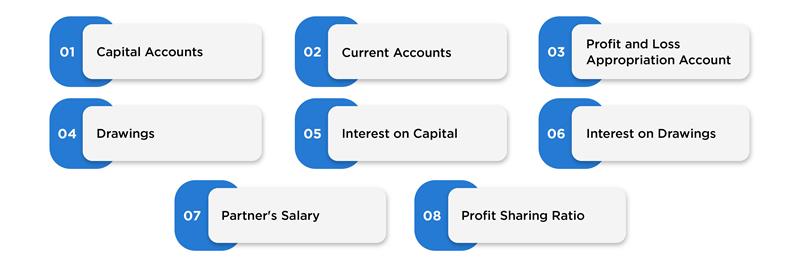
1. Capital Accounts
- Money that each partner puts into the business
- Shows how much each partner has invested
- Can be fixed (stays the same) or fluctuating (changes over time)
2. Current Accounts
- Like a personal running account for each partner
- Records day-to-day transactions with the business
- Includes things like drawings, profit share, interest, and salaries
3. Profit and Loss Appropriation Account
- Shows how profits (or losses) are divided among partners
- Takes the net profit from the business
- Splits it according to the partnership agreement
4. Drawings
- Money or goods that partners take out for personal use
- Reduces their stake in the business
- Recorded separately for each partner
5. Interest on Capital
- Extra payment partners get based on their investment
- Reward for putting money into the business
- Calculated as a percentage of their capital
6. Interest on Drawings
- Charge against partners for taking money out
- Discourages excessive withdrawals
- Added back to the business profit
7. Partner’s Salary
- Fixed payment for active work done by a partner
- Not related to profit sharing
- Given before profits are divided
8. Profit Sharing Ratio
- The agreed formula for splitting profits
- Could be equal or based on contribution
- Must be clearly stated in the partnership deed
What is an Appropriation Account?
An Appropriation Account shows how the partnership’s net profit is divided among partners – including any agreed partner salaries, interest on capital contributions, and each partner’s final profit share as per the partnership agreement.
Example – 2 Partner Business (50:50 Split)
| Item | Amount |
| Net Profit | £120,000 |
| Less: Partner A Salary | (£20,000) |
| Less: Interest on Capital | (£5,000) |
| Remaining Profit (shared 50:50) | £95,000 |
| Partner A Share | £47,500 |
| Partner B Share | £47,500 |
The Appropriation Account is prepared after the Profit & Loss Account and forms a key part of your annual partnership accounts.
Core Services in Partnership Accounting
Here are the main services that partnership accountants provide:
1. Formation Services
- Help set up the partnership legally and financially
- Create partnership agreements that outline how profits and losses will be shared
- Register the business with tax authorities
- Set up the initial capital accounts for each partner
2. Bookkeeping and Record-Keeping
- Track all money coming in and going out
- Record daily transactions like sales, expenses, and purchases
- Maintain separate accounts for each partner showing their investments and withdrawals
- Keep organized financial records for tax purposes
Simplify your finances with our expert bookkeeping services, get professional support today!
3. Capital Account Management
- Monitor each partner’s investment in the business
- Track additional money partners put in or take out
- Calculate each partner’s current ownership stake
- Record changes when partners join or leave
4. Profit and Loss Distribution
- Calculate the business’s total profit or loss each period
- Divide profits/losses among partners based on their agreement
- Handle different sharing ratios (like 50-50 or 60-40 splits)
- Account for partner salaries, interest on capital, or other special arrangements
5. Financial Statement Preparation
- Create income statements showing business performance
- Prepare balance sheets showing assets, liabilities, and partner equity
- Generate capital statements showing changes in each partner’s account
- Produce reports for partners to review business health
6. Tax Services
- Prepare partnership tax returns
- Calculate each partner’s share of taxable income
- Provide tax documents (like Schedule K-1) to each partner
- Advise on tax-saving strategies
7. Admission and Retirement of Partners
- Handle accounting when new partners join
- Calculate buyout amounts when partners leave
- Adjust capital accounts when ownership changes
- Record goodwill or asset revaluations if needed
8. Dissolution and Liquidation
- Manage finances when the partnership ends
- Sell off assets and pay debts
- Distribute remaining money to partners fairly
- Close all accounts properly
Why Partnership Accounting Services are important?
The decision to hire specialised accounting services moves beyond mere convenience it becomes a strategic necessity for a multi-owner business.
1. Ensure accuracy
Partnership finances are inherently complex. An expert minimises the risk of errors in allocating shared income and expenses across individual partner accounts, maintaining precise records.
2. Promote transparency and fair profit sharing:
Using an impartial, professional third party to calculate and document the profit distribution, as detailed in the Appropriation Account, removes internal bias and validates fairness, a key pillar of partner trust.
3. Ensure compliance with UK Tax Laws (HMRC Requirements)
Accountants guarantee the timely and accurate filing of the Partnership Tax Return (SA800), managing complex tax calculations, including the recent complications arising from the Basis Period Reform (where profits may need to be apportioned to align with the tax year).
4. Help avoid disputes
Many partnerships disagreements stem from financial misunderstandings. Clear, professionally audited records provide the authoritative truth needed to resolve disagreements quickly.
5. Assist in financial decision-making
Accurate financial data allows partners to make informed choices on investment, expansion and cost management, giving the business a strong platform for sustainable growth.
6. Support with partner admissions and exits
Accountants ensure smooth handling of financial adjustments when a new partner joins or an existing partner leaves, including goodwill valuation, revaluation of assets, and settlement of withdrawing partner accounts.
7. Cash flow and working capital management
Specialised accountants monitor cash inflows and outflows, helping partnerships avoid liquidity issues and ensuring sufficient working capital to maintain operations efficiently.
8. Strategic tax planning
Beyond compliance, accountants help partnerships optimise tax efficiency, take advantage of available reliefs, and structure income allocation in a way that legally minimises tax burdens for each partner.
9. Enhanced credibility with lenders and investors
Audited and professionally managed accounts improve the partnership’s ability to secure funding or investment by demonstrating financial stability and reliability.
10. Technology and digital tools integration
Modern accountants leverage cloud-based software and digital reporting platforms to provide real-time financial insights, streamline record-keeping, and enhance collaboration among partners.
11. Long-term business growth and exit strategy planning
Accountants also advise on succession planning, mergers, acquisitions, or exit strategies, ensuring that future transitions are financially sound and aligned with the long-term goals of the partners.
Partnership Accounts Preparation Workflow
While preparing partnership accounts several careful steps are taken to ensure the final figures are legally correct and accurate. This systematic process ensures compliance for any accountancy partnership.
- Data collection: Gather bank statements, sales and purchase ledgers, invoices, expense receipts, payroll records, VAT/PAYE returns (if applicable), fixed asset register, inventory/WIP counts and the signed partnership agreement.
- Framework and opening balances: Set the accounting framework (e.g., FRS 102 Section 1A or FRS 105 where appropriate) and include a brief basis of preparation note; agree opening balances to prior year signed accounts and confirm profit-sharing ratios, partner salaries and interest rates on capital/drawings.
- Partner accounts policy: Confirm whether fixed capital accounts with separate current accounts are used, and plan to present movement schedules for each partner showing brought forward, appropriations, drawings and carried forward balances.
- Year-end adjustments: Post accruals and prepayments, depreciation/amortisation, stock/WIP valuation, bad debt provisions, and partner-specific appropriations (e.g., partner salaries and interest on capital as appropriations, not expenses).
- Statement preparation: Prepare the profit and loss account and balance sheet, then the appropriation account in sequence: allocate partner salaries, interest on capital, charge interest on drawings, and distribute the residual profit per the agreed ratio.
- Reconciliation: Ensuring all figures are balanced and correct, making the accounts ready for the new financial period.
- Partner capital/current schedules: Produce tabular movements for each partner: opening balance, salaries, interest on capital, drawings, interest on drawings, share of profit/loss, and closing balance.
- Compliance mapping: Map figures to the Partnership Tax Return (SA800), confirm the nominated partner’s responsibility for submission, and account for Basis Period Reform apportionments if the accounting year-end differs from 31 March/5 April.
- Entity-specific filings: If an LLP or a qualifying partnership, prepare Companies House-compliant accounts, consider audit thresholds and meet filing deadlines; for ordinary partnerships, retain accounts for HMRC support and partner transparency.
- Digital records and review: Maintain digital records with clear audit trails using cloud accounting, perform a critical review for consistency and disclosures and document materiality judgments and key accounting policies.
- Final approval by partners and sign-off: Circulate drafts (accounts, partner schedules, reconciliation pack) for partner review, incorporate feedback, obtain formal approval/signatures and archive working papers securely.
A. Compliance for General Partnerships
General Partnerships are unincorporated and primarily deal with HMRC.
- Partnership Tax Return (SA800):
- What it is: The principal tax return for the partnership itself. It reports the overall business income, expenses and most importantly, how the final profit or loss has been allocated among the partners.
- Who files: The nominated partner is responsible for submitting this return to HMRC, but all partners are jointly liable for timely submission.
- Filing Deadlines:
- 31 October following the tax year (if filing on paper).
- 31 January following the tax year (if filing online).
- From 2025, partnerships with turnover exceeding £15 million must submit full accounts with their SA800 return.
- If your partnership’s accounting period does not align with the tax year, profits must be apportioned to the correct tax year under the Basis Period Reform.
- Individual Self Assessment (SA100 and SA104):
- Partner Responsibility: Each individual partner must report their specific share of the profit or loss (as detailed on the SA800) on their personal Self Assessment tax return (SA100), using the supplementary partnership page (SA104).
- Tax Payment: The tax liability rests entirely with the individual partners, not the partnership entity.
- Filing Deadline: 31 January following the tax year.
B. Compliance for Limited Liability Partnerships (LLPs)
LLPs are incorporated and must satisfy two different government bodies: HMRC (for tax) and Companies House (for public disclosure).
- Filing with Companies House (Statutory Accounts):
- What it is: As a separate legal entity, the LLP must prepare and file Statutory Accounts (including a Balance Sheet and Profit and Loss Account) for public record.
- Filing Deadline: Within nine months of the LLP’s financial year-end.
- From 18 November 2025, new LLP members must verify their identity before notifying Companies House of their admission.
- Penalties: Failure to meet this deadline results in automatic, escalating financial penalties from Companies House.
- Filing with HMRC (Partnership Tax Return – SA800):
- The LLP must still file the SA800 tax return with HMRC, detailing profit allocation.
- The tax process remains tax-transparent: profits are still taxed only at the individual partner level via Self Assessment.
C. The cost of Non-Compliance
Professional accounting services are essential for managing these dual responsibilities:
- HMRC Penalties: Late filing of the SA800 results in automatic, initial penalties that quickly escalate with further delay.
- Companies House Penalties (LLPs): Late filing of statutory accounts results in substantial fines, damages the LLP’s public reputation, and can lead to striking-off action.
- Failure to verify the identity of new LLP members or submit statutory accounts on time can result in further penalties and reputational damage.
Expert services ensure that the correct documentation is prepared and submitted to the right authority by the correct deadline.
Making Tax Digital (MTD) – What Partnerships Need to Know
HMRC has confirmed that partnerships will be included in Making Tax Digital for Income Tax in a future phase. While no mandatory start date has been set for partnerships yet, HMRC strongly encourages all partnerships to:
- Switch to MTD-compatible software (e.g., Xero, QuickBooks, Sage)
- Maintain digital records of all income and expenses now
- Speak to their accountant about MTD preparation
Getting ready now avoids a rushed transition when the deadline is announced
Conclusion
Strong partnership accounting isn’t paperwork, it’s how you protect relationships, cash flow and growth. When capital accounts, current accounts and the profit and loss appropriation account are maintained with disciplined bookkeeping, clear profit sharing and timely HMRC compliance, partners get the transparency they need to make confident decisions.
For LLPs, Companies House filing deadlines add pressure, structured workflows, digital record‑keeping and audit‑ready controls reduce risk and prevent costly surprises. The right partnership accountants align daily transactions with the partnership agreement, manage partner admissions and exits, support tax planning and prepare accurate statutory and management accounts. With cloud accounting and real‑time reporting, you’ll streamline SA800 and Self Assessment submissions while strengthening credibility with lenders and investors.
If you want precise books, fair profit allocation and stress‑free year‑end, bring in specialists who do this every day.
Book your consultation today; call 01923 856 008 or email office@danielwolfson.co.uk
FAQs
How to do accounting for partnerships?
Partnership accounting means keeping clear records of income and expenses, having separate Capital and Current Accounts for each partner, preparing the Profit & Loss Account, Balance Sheet, and an Appropriation Account to show how profits are shared
Do I need an accountant for a partnership?
It’s not always a legal requirement (except for LLPs), but using an accountant is very helpful. They can handle tax rules, profit sharing and UK tax changes, which can be tricky to manage on your own.
Do partnerships need to prepare accounts?
Yes, all partnerships must prepare accounts (P&L and Balance Sheet) for tax purposes. LLPs must file these statutory accounts publicly with Companies House.
What records does a partnership need to keep?
Partnerships must keep records of all business transactions, details of each partner’s capital and drawings and copies of tax returns such as SA800 and each partner’s Self Assessment.
What is limited partnership accounting?
This type of accounting separates the roles of General Partners (who have unlimited liability) and Limited Partners (whose liability is limited to their investment). Profits and losses are shared based on these roles.
What happens when a partner joins or leaves a partnership?
When a partner joins, capital contributions are agreed, goodwill may be valued, and existing accounts are adjusted. When a partner leaves, their capital and current account balances are settled, and remaining partners update their profit-sharing ratios. An accountant ensures all adjustments are legally and financially accurate.
What is partnership accounting?
Partnership accounting is the structured system for recording, reporting, and allocating a UK partnership’s financial activity so that profits and losses are shared exactly as set out in the partnership agreement, with separate tracking of each partner’s capital, drawings, and final profit distribution.
What records must a UK partnership keep?
Partnerships must keep records of all business transactions, details of each partner’s capital and drawings, and copies of tax returns such as SA800 and each partner’s Self Assessment.
Do partnerships pay tax in the UK?
Partnerships do not pay tax directly. Instead, each partner or member is taxed on their share of the profits, calculated and paid through their personal tax return. The partnership then files an annual partnership tax return to HMRC detailing its income and business expenses.
What is the SA800 deadline?
The paper filing deadline for the partnership tax return is 31 October – missing it triggers an automatic £100 penalty per partner.
The online filing deadline is 31 January following the tax year end.
How do I register a new partnership with HMRC?
New partnerships must register by 5th October following the end of their first tax year to avoid penalties.
Each partner must also register for Self Assessment individually so HMRC can issue them their own SA100 and SA104 requirements.
Do I need an accountant for my partnership?
While it is not always a legal requirement (except for LLPs), using an accountant is very helpful as they can handle tax rules, profit sharing, and UK tax changes, which can be tricky to manage on your own.
About the Author