A limited company can make pension contributions for a director, and an allowable employer contribution can reduce the company’s taxable profits without being treated as taxable employment income for the director. The contribution still counts towards the director’s pension annual allowance.
For owner-managed companies, pension contributions can form part of a wider remuneration strategy. They can provide a different way to use company profits compared with salary or dividends, while also building pension savings for the director.
This guide is for limited company directors and owner-managed businesses considering pension contributions in 2026/27. It explains the main tax benefits, how much a company can contribute, the Corporation Tax rules, how pension contributions compare with salary and dividends, and what to check before making a payment.
Key takeaways
- An allowable employer pension contribution can reduce a company’s taxable profits.
- The contribution is not normally treated as taxable employment income for the director.
- The standard pension annual allowance is £60,000 for 2026/27.
- Carry-forward can increase the available allowance, subject to the relevant conditions.
- Tapering and the Money Purchase Annual Allowance can reduce the amount available.
- The Corporation Tax deduction is normally based on when the contribution is paid.
How do Pension Contributions work for a Limited Company Director?
A limited company can pay an employer contribution into a registered pension scheme for its director. The company makes the payment, while the contribution is included when calculating the director’s pension savings for annual allowance purposes.
The key distinction is whether the money is paid by the company or the director personally. This affects how tax relief is obtained and how the payment is recorded.
Employer vs Personal Pension Contributions
| Contribution type | Who pays? | Main tax treatment |
|---|---|---|
| Employer contribution | Limited company | May be deductible for Corporation Tax if the relevant conditions are met |
| Personal contribution | Director | Personal tax relief applies under the pension contribution rules |
| Employer + personal contributions | Company and director | Both count towards the director’s pension annual allowance |
There is no £60,000 limit on the amount a company can pay into a director’s pension. The £60,000 figure is the standard annual allowance against which the director’s total pension savings are tested for 2026/27.
Why the distinction is important for director-shareholders:
A director who owns shares in the company can receive value through salary, dividends or employer pension contributions. Each has a different tax treatment, so the choice should be considered against company profits, the director’s pension position and the need for personal access to the money.
What are the Tax Benefits of Pension Contributions?
The main benefits arise from the way employer pension contributions are treated for Corporation Tax, Income Tax and National Insurance. An allowable company contribution can reduce taxable profits, while the contribution itself is not normally charged on the director as employment income.
| Tax benefit | How it works |
|---|---|
| Corporation Tax relief | An allowable employer contribution can reduce the company’s taxable profits. |
| No Income Tax on the contribution | An employer contribution to a registered pension scheme is not normally charged on the director as employment earnings. |
| No employee Class 1 NIC on the contribution | The employer contribution is not treated as earnings for employee Class 1 National Insurance purposes. |
| Carry-forward potential | Unused annual allowance from the previous three tax years can increase the amount available, subject to the rules. |
| Pension tax relief | Pension contributions can receive tax relief within the applicable pension rules and allowances. |
These benefits do not mean that every company contribution automatically receives tax relief. The payment still needs to meet the Corporation Tax rules, while the director’s available pension allowance determines whether an annual allowance charge can arise.
Corporation Tax relief
An employer contribution to a registered pension scheme can be an allowable business expense when it is paid wholly and exclusively for the purposes of the trade. HMRC specifically applies this rule to contributions made for controlling directors and shareholders.
For 2026, the Corporation Tax small profits rate is 19% for profits of £50,000 or less. The main rate is 25% for profits above £250,000, with Marginal Relief applying between the two thresholds. The thresholds can be affected by associated companies and accounting periods shorter than 12 months.
A £20,000 allowable pension contribution reduces taxable profits by £20,000. The actual Corporation Tax saving depends on the company’s applicable rate.
No Income Tax or Employee National Insurance on the contribution
Employer contributions to a registered pension scheme are not chargeable on the director as earnings from employment. This means the contribution is not treated like salary for Income Tax purposes.
Employer pension contributions are also excluded from the employee’s earnings for Class 1 National Insurance purposes. This is different from salary, where Income Tax and National Insurance can apply depending on the director’s earnings.
The contribution still counts towards the director’s pension annual allowance, so avoiding an immediate Income Tax charge does not remove the pension limits.
Pension tax relief and carry-forward
Pension saving benefits from tax relief within the pension rules. For 2026/27, the standard annual allowance is £60,000, and unused allowance from the previous three tax years may be carried forward when the relevant conditions are met.
This can be particularly useful when a company wants to make a larger contribution in one year rather than making equal payments every year.
How much can a Limited Company contribute to a Director’s Pension?
The amount a company pays and the amount the director can contribute without an annual allowance charge are separate questions. A company can make a contribution above £60,000, but the director needs sufficient available annual allowance, including valid carry-forward where applicable.
The £60,000 annual allowance
The standard annual allowance is £60,000 for 2026/27. It applies across the director’s pension arrangements, rather than providing a separate allowance for each pension. Employer and personal pension contributions are included when assessing the allowance.
A director with multiple pension arrangements therefore needs to consider the combined pension input for the tax year before deciding how much the company should contribute.
Can unused allowance be carried forward?
Yes, unused annual allowance from the previous three tax years can be carried forward, subject to the relevant conditions. This can increase the amount available above the standard £60,000 allowance for 2026/27.
For a large one-off contribution, the calculation needs to account for pension savings already made in each relevant year before the available carry-forward is established.
When can the available allowance be lower?
The available allowance can be lower where the director has high income or has flexibly accessed pension benefits.
For 2026/27, tapering can apply when both threshold income is over £200,000 and adjusted income is over £260,000. The tapered annual allowance can reduce to a minimum of £10,000.
The Money Purchase Annual Allowance is £10,000 for 2026/27 and can apply after certain forms of flexible pension access.
A director planning a substantial contribution should review existing pension savings, income and any previous flexible access before the company makes the payment.
When is a Director’s Pension Contribution Tax-Deductible?
A pension contribution is not deductible simply because it is paid into a director’s pension. For a trading company to claim Corporation Tax relief, the contribution must meet the relevant rules for a trading expense, including the wholly and exclusively test.
Before claiming the deduction, the company should check the main conditions that affect whether the contribution qualifies and when the relief can be claimed.
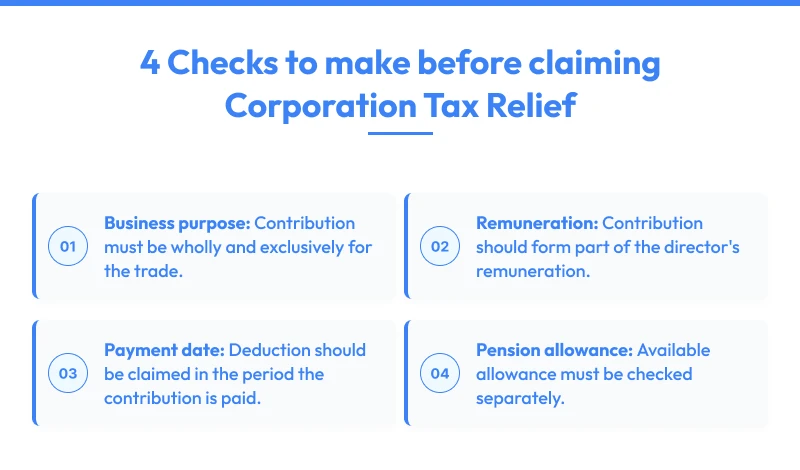
These checks provide the starting point for assessing the company’s tax treatment. The business purpose and remuneration of the director are particularly relevant where the contribution is made for a director-shareholder.
The wholly and exclusively test
HMRC states that a pension contribution must be paid wholly and exclusively for the purposes of the trade to be deductible. Pension contributions form part of the normal cost of employing staff, so they can be allowable where there is no identifiable non-trade purpose.
The company should retain appropriate records showing the contribution as part of the director’s remuneration arrangements and business expenditure.
Director-shareholders and controlling directors
A director’s control of the company does not, by itself, prevent a pension contribution from being deductible.
HMRC states that where a contribution forms part of a remuneration package paid wholly and exclusively for the purposes of the trade, it can be an allowable expense. The facts of the individual company determine whether a non-trade purpose exists. HMRC also notes that an excessive overall remuneration package may require further consideration.
This is particularly relevant when an owner-director makes a large contribution that is substantially different from previous remuneration.
When does the company receive the deduction?
The payment date is important. HMRC states that employer contributions to registered pension schemes are deducted for the accounting period in which they are paid, rather than simply the period in which they are recorded in the accounts.
A contribution recorded before year-end but paid after year-end will therefore not normally give Corporation Tax relief in the earlier accounting period.
There is also a specialist spreading rule where employer contributions to a particular pension scheme increase by more than 210% from one accounting period to the next, unless the increase is below £500,000. This can affect the timing of the deduction for larger changes in contribution levels.
Employer Pension Contributions vs Salary and Dividends
A director considering how to extract value from a company needs to compare the tax treatment of salary, dividends and pension contributions. The right comparison also depends on whether the director needs the money now or is prepared to leave it invested for retirement.
| Payment method | Company treatment | Director-level treatment | Key consideration |
|---|---|---|---|
| Salary | Usually deductible as remuneration where allowable | Subject to Income Tax and relevant NIC rules | Provides immediate personal income |
| Dividend | Paid from post-tax company profits | Dividend tax can apply above the £500 Dividend Allowance | Requires sufficient distributable profits |
| Employer pension contribution | May be deductible if the conditions are met | Not normally charged as employment income | Uses the director’s pension allowance |
For 2026/27, the Dividend Allowance is £500. Dividends above the allowance are taxed at 10.75%, 35.75% or 39.35%, depending on the applicable tax band.
A pension contribution also differs from salary and dividends because the money is placed into a pension rather than becoming immediately available personal income.
Pension Contribution Examples for Limited Company Directors
The tax outcome depends on the director’s wider pension position and the company’s circumstances. The following three examples show how different contribution patterns interact with the annual allowance.
A £20,000 employer contribution
A company pays £20,000 into its director’s registered pension scheme during 2026/27.
If the director has sufficient available annual allowance and the contribution meets the wholly and exclusively test, the £20,000 can be an allowable company expense. It also uses £20,000 of the director’s pension annual allowance.
A £70,000 employer contribution
An owner-director decides that the company should make a £70,000 one-off pension contribution during 2026/27.
The payment is not automatically disallowed because it exceeds the £60,000 standard annual allowance. If the director has sufficient unused allowance available through carry-forward, the contribution can be covered by the available allowance. Without enough available allowance, the excess can result in an annual allowance charge.
Employer and personal contributions in the same year
A director pays £15,000 personally into a pension while the company pays a further £45,000 employer contribution during 2026/27.
The two amounts are considered together for annual allowance purposes, giving total pension savings of £60,000 for the year. The company contribution does not receive a separate £60,000 allowance simply because the company makes the payment.
What should a Director check before making a Pension Contribution?
A contribution should be reviewed before payment, particularly when the amount is substantial or differs from the director’s usual remuneration. The review needs to cover both the company’s Corporation Tax position and the director’s pension allowance.
Use this checklist:
- Annual allowance: Calculate all relevant pension inputs for 2026/27.
- Carry-forward: Check unused allowance from the previous three tax years.
- Tapering: Establish whether the director’s income means a tapered allowance applies.
- Flexible access: Check whether the Money Purchase Annual Allowance has been activated.
- Company profits: Review the effect of the contribution on taxable profits and available cash.
- Business purpose: Confirm that the contribution can be supported as a business expense.
- Payment date: Check when the contribution will be paid if Corporation Tax relief is expected for a particular accounting period.
- Contribution history: Review previous company pension payments, particularly where the proposed contribution is substantially higher.
- Records: Keep payment evidence and supporting remuneration and pension allowance calculations.
These checks can prevent an expected Corporation Tax deduction or pension allowance from being calculated incorrectly.
How can Daniel Wolfson & Co help with Director Pension Contributions?
Daniel Wolfson & Co provides accounting and tax support for limited companies, including annual and statutory accounts, Corporation Tax returns, director Self Assessment, tax planning advice, payroll and business advice. Its published limited company services also cover management accounts and wider accounting support.
For a director considering pension contributions, this accounting and tax support can help place the payment within the company’s wider financial and tax position. Daniel Wolfson & Co can also provide business advice and tax planning as part of its limited company accounting services.
For advice on your company’s tax position, remuneration planning or the accounting treatment of a director pension contribution, book a consultation with Daniel Wolfson & Co or email office@danielwolfson.co.uk.
Conclusion
Employer pension contributions can provide a tax-efficient way for a limited company to fund a director’s pension while potentially reducing taxable company profits. The contribution is not normally charged as employment income, but it still uses the director’s available pension allowance.
For 2026/27, the standard annual allowance is £60,000, with carry-forward available subject to the relevant conditions. Tapering and the Money Purchase Annual Allowance can reduce the available amount, while the Corporation Tax deduction depends on the purpose of the contribution and when it is paid.
FAQs
Can a limited company make a pension contribution for a director who takes no salary?
Yes, an employer can make a contribution to a registered pension scheme for a director without the payment being charged as employment income. The company must still satisfy the Corporation Tax deduction rules and the director’s pension allowance rules.
Can pension contributions from different employers use the same annual allowance?
Yes, the annual allowance applies across the individual’s pension arrangements. Contributions from different employers therefore need to be included when calculating the director’s total pension savings for the tax year.
Can a company make a large pension contribution in one payment?
Yes, there is no £60,000 limit on the size of an employer contribution. The director needs sufficient available annual allowance, including valid carry-forward where applicable, while the company must satisfy the rules for Corporation Tax relief.
What happens if a contribution is recorded before the company year-end but paid afterwards?
The Corporation Tax deduction is normally given for the accounting period in which the employer contribution is paid. Recording the amount in the accounts before year-end does not by itself move the tax deduction into that earlier period.
Can a pension contribution be deductible when the director controls the company?
Yes, control does not by itself prevent a deduction. HMRC states that a contribution can be allowable when it forms part of a remuneration package paid wholly and exclusively for the purposes of the trade, with the facts determining whether a non-trade purpose exists.
About the Author