Many taxpayers rush to submit their self-assessment tax return, only to discover later that small mistakes have triggered HMRC penalties, refund delays, or stressful investigations. With significant changes to allowances, reliefs and filing requirements coming in the 2026/27 tax year, understanding how to review your tax return has never been more critical. These common tax return errors, from incomplete income records to calculation oversights, can often be avoided with a careful tax return final review. This guide also explains the difference between mistakes on an individual tax return and HMRC calculation issues reported in the news.
Whether you file online every year or it’s your first time learning how to review your tax return, understanding how to check your tax return before submission is crucial. A structured tax return review checklist not only helps ensure accuracy but also gives you peace of mind knowing your Self-Assessment is compliant and error-free.
This comprehensive review checklist will help you ensure your tax return is accurate before submission.
This guide covers:
- Important HMRC documents you need to understand
- How to access and review your tax return online
- Preparing and organising your financial records
- Common tax return errors to watch out for
- A systematic checklist for reviewing your return
- How to use technology to simplify the review process
- HMRC’s penalty structure and how to avoid fines
- Planning ahead for 2026/27 tax changes
- When to seek professional tax advice
By following this guide, you can file your tax return confidently and avoid costly mistakes.
Why the final review of your tax return is important
Submitting your tax return without a thorough final review can lead to costly consequences. HM Revenue & Customs (HMRC) may flag inconsistencies or mistakes. Errors can result in penalties, interest charges or additional checks, depending on the circumstances.
As we approach the 2026/27 tax year, careful review becomes even more important as tax allowances and rates may change.
Many taxpayers rush through the process and overlook essential details before they submit their tax return. Conducting a careful final review of your Self Assessment tax form protects you from:
- Penalties and fines for errors or late filing
- Refund delays when HMRC needs more information
- HMRC investigations or audits triggered by inaccuracies
- Missing applicable allowances and reliefs
A well-organised review ensures accuracy and completeness in your Self Assessment, giving you peace of mind that your tax affairs are accurate and compliant before submission.
Important HMRC documents
Before you begin your tax return review, familiarise yourself with the core documents that help you check your Self Assessment:
- SA100 (Self Assessment tax return form): This form includes the income, gains and reliefs you declare for the tax year.
- SA302 (tax calculation): This calculation shows the tax liability based on the information submitted to HMRC.
Comparing your tax return with the tax calculation helps you spot discrepancies between your declared figures and the calculated tax. Check that you are comparing documents for the correct tax year and that you understand whether a calculation is an estimate or a final calculation.
How to access your tax return for review
To conduct a thorough tax return review, you must first access your relevant documents and calculations using your HMRC Personal Tax Account.
- Sign in or create your account at GOV.UK using your Government Gateway user ID and password.
- Once logged in, navigate to the Self Assessment section and select the relevant tax year.
- Download your tax return and tax calculation, where available, for side-by-side review.
- Keep your login credentials secure and consider using the official HMRC app for convenient access to your tax information.
- If you need to correct a return before submission, update the relevant entries before submitting it.
Preparing your financial records for review
Before you start your tax return final review, gather all necessary supporting documents to ensure accuracy and completeness:
- Employment income forms: P60, P45 and P11D, where applicable.
- Bank and building society statements: Showing interest received.
- Pension and state benefits letters: For relevant payments and contributions.
- Allowable business expenses: Receipts, invoices, mileage logs and expense reports.
- Pension contributions and charitable donations: Payment confirmations or statements.
- Details of additional income: Rental, dividend, foreign, freelance and other taxable income.
- Expense records: Relevant receipts and documentation for every claim made.
- Tax-year guidance: The allowances and reliefs applicable to the tax year you are filing.
Organising these documents before you check your tax return lets you quickly cross-reference totals, verify correct reporting and reduce the risk of missing crucial data or making calculation mistakes.
Want to ensure your documentation, compliance deadlines and statutory filings are handled seamlessly? Our expert company secretarial services support small businesses, limited companies and partnerships with reliable, professional record-keeping and filing.
The top common tax return errors to avoid
Understanding the most frequent mistakes taxpayers make is your first line of defence against filing errors. These common tax return errors occur across all taxpayer types, from first-time filers learning how to do a tax return online to experienced self-employed individuals managing their own Self Assessment submissions.
By familiarising yourself with these pitfalls, you can use this knowledge as an essential part of your tax return review checklist for a smooth and compliant filing process.
1. Incorrect personal information
One of the most basic yet surprisingly common tax return errors involves personal details. Double-check that your:
- Name matches HMRC records exactly
- National Insurance number is correct
- Address is current and complete
- Contact details are up to date
Even small discrepancies can cause processing delays. When you complete a tax return, verify these details first before moving to financial sections.
2. Mathematical mistakes
Despite automated calculations in most tax filing software, errors can occur when you transfer figures between documents or enter information manually.
Recent HMRC tax calculation issue reported in September 2026
On 4 September 2026, news reports stated that HMRC would manually review around 107,000 tax calculations following a technical issue affecting the application of certain allowances and tax bands. The reported issue concerned how some calculations applied the beneficial ordering of allowances and tax bands.
This reported HMRC calculation issue is different from an individual making a mistake on their Self Assessment tax return. It does not mean every taxpayer or every tax calculation is affected. If you believe your tax calculation may be incorrect, review the figures and relevant allowances carefully and contact HMRC or a qualified tax adviser if you need assistance.
For background, see the HMRC Self Assessment guidance and verify any updates against current official guidance.
How to avoid calculation errors: Always double-check calculations, especially when:
- Adding up multiple income sources
- Calculating allowable expenses
- Working out tax relief claims
- Computing capital gains
Use a calculator or spreadsheet to verify totals independently, even if you’re using software.
3. Missing or incomplete income
One of the most serious common tax return errors is failing to declare all relevant income sources. HMRC may receive information from employers, banks, pension providers and other sources, so discrepancies can lead to additional checks. Ensure you include:
- Employment income from all jobs
- Self-employment profits
- Rental income from properties
- Investment income and dividends
- Foreign income, where applicable
- Taxable benefits and pension income
- Freelance or gig economy earnings
When learning how to fill in tax return forms properly, create a comprehensive tax return review checklist before you begin. Missing income can lead to additional tax, interest and penalties depending on the circumstances.
4. Incorrect tax code information
Your tax code determines how much tax is generally deducted from employment or pension income through PAYE. Incorrect tax code information can contribute to discrepancies in your tax calculation.
Check your P60 or payslips to confirm the tax code used during the relevant tax year. If it seems wrong, contact HMRC to clarify it before submitting your return.
5. Overlooked allowances and reliefs
Many taxpayers overpay tax by not claiming legitimate allowances. Common areas to review include:
- Personal Allowance: £12,570 for 2026/27, subject to the rules that apply to your circumstances.
- Marriage Allowance, where eligible
- Trading Allowance, where applicable
- Property Allowance, where applicable
- Pension contribution relief
- Charitable donation relief through Gift Aid
- Allowable professional subscription costs
These tips for tax returns can help you identify legitimate tax reliefs. Research all applicable reliefs as part of your tax return guidance and ensure your final review includes checking the eligibility criteria.
Important: Allowances and reliefs depend on your circumstances and the tax year. Check the relevant HMRC guidance before claiming them.
6. Expense claim errors
For self-employed individuals filing income tax returns, expense claims require particular attention. Common mistakes include:
- Claiming personal expenses as business costs
- Lacking proper receipts and documentation
- Incorrectly apportioning mixed-use expenses, such as home office costs
- Claiming capital items as ordinary expenses when capital allowances may apply
- Over-claiming mileage
HMRC may check expense claims. When you complete a tax return with business expenses, ensure every claim is allowable and properly documented.
7. Student loan repayment errors
If you have a student loan, you may need to include the relevant information in your tax return. Failing to include student loan information or selecting the wrong repayment plan can result in an incorrect calculation.
Check your student loan records and the applicable HMRC guidance before completing the relevant sections.
8. Capital gains tax mistakes
Capital gains calculations involve rules around allowable losses, annual exempt amounts and different asset types. Common errors include:
- Not applying the annual exempt amount that applies to the relevant tax year
- Forgetting to offset eligible losses from previous years
- Miscalculating acquisition and disposal costs
- Applying the wrong tax rate
For the 2025/26 tax year, the annual exempt amount for individuals is £3,000. Check the applicable rules and figures for the tax year you are filing.
Tax return examples for capital gains can be found on the HMRC website to help you understand correct reporting methods.
Capital gains tax rates and dividend tax rates can vary by tax year and taxpayer circumstances. Check current official guidance before calculating your liability.
If you’re concerned about calculating capital gains correctly or want to understand the reliefs available to you, our experienced capital gains tax accountants can help you understand the rules and ensure your reporting is accurate.
Contact our capital gains tax accountants for professional support with complex capital gains tax calculations.
9. Bank account details
If you’re due a refund, incorrect bank details can delay payment. When you check your tax return before submission, verify that:
- The account number is complete and correct
- The sort code matches your bank
- The account details are entered accurately
- Any relevant building society reference is included
This simple step in your tax return review checklist helps ensure refunds can be paid to the correct account.
10. Confusion with deadlines
Missing filing or payment deadlines can result in penalties and interest. Key Self Assessment dates include:
- 5 October: Registration deadline for some people who need to register for Self Assessment for the first time.
- 31 October: Paper tax return deadline.
- 31 January: Online filing deadline and payment deadline for the relevant tax year.
- 31 July: Second payment on account deadline, where applicable.
For the 2025/26 tax year, the online filing and payment deadline is 31 January 2027. For the 2026/27 tax year, the online filing and payment deadline is 31 January 2028.
Always check the applicable deadline and any exceptions on GOV.UK.
Set reminders well before these dates to avoid late filing or payment penalties. Consider starting your HMRC tax return review early to identify common tax return errors before they become issues.
For small business owners and self-employed professionals, maintaining accurate, up-to-date records all year round makes tax season easier. Our expert management accounting services provide regular financial reports, cash flow insights and tailored advice so you’re better prepared for your financial reporting requirements.
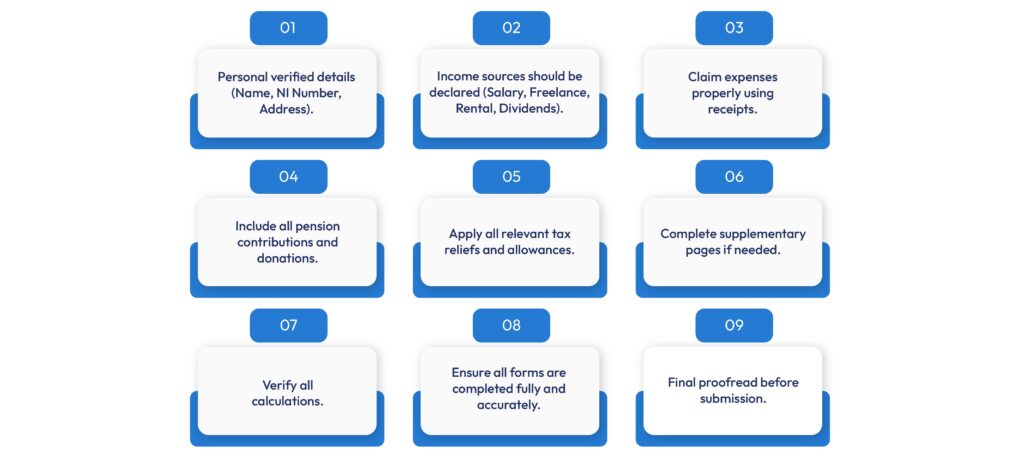
Quick Tax Return Checklist:
How to review your tax return systematically
Follow this comprehensive tax return review checklist when you conduct your final review to ensure accuracy before you submit your tax return online to HMRC. A careful review helps you avoid common tax return errors and ensures that all information aligns with official records.
Personal information section
- Verify all personal details match HMRC records exactly.
- Confirm contact information is current and complete.
- Check your National Insurance number for accuracy.
- Ensure the address matches your latest correspondence with HMRC.
Income section
- Cross-reference all income sources with documentation, including P60s, P45s, dividend vouchers and self-employment statements.
- Ensure foreign income is included and converted correctly using the applicable HMRC guidance.
- Verify rental income, freelance or gig work and interest from savings are accurately reported.
- Confirm relevant state benefits and pensions are declared.
- Compare income entries with the information in your HMRC online account to identify possible omissions.
Expenses and allowances
- Confirm all expense claims have valid supporting receipts or digital records.
- Check the Personal Allowance that applies to the relevant tax year.
- Verify pension contributions are accurately stated and receive the appropriate relief.
- Review charitable donations for Gift Aid eligibility.
- Ensure trading and property allowances are correctly claimed where relevant.
- Check professional fees and subscriptions against HMRC guidance.
Calculations
- Independently verify mathematical calculations using a calculator or spreadsheet.
- Check tax reliefs are computed accurately, including Marriage Allowance and capital allowances.
- Confirm capital gains calculations reflect acquisition costs, allowable expenses and the annual exempt amount applicable to the tax year.
- For 2026/27, verify dividend tax calculations against current HMRC guidance and use the rate applicable to your income band.
- Review Self Assessment totals for consistency between income, expenses and tax due.
Supporting information
- Ensure all supplementary pages for self-employment, partnerships, foreign income, capital gains and other relevant income are included.
- Verify student loan details where applicable, ensuring the correct plan type is selected.
- Check bank details for refunds are correct.
- Include relevant explanations or supporting information where required.
Final steps
- Save a PDF copy or digital backup of your completed tax return for future reference.
- Note your submission reference number after online filing.
- Arrange payment promptly if tax is due.
- Check your tax return using HMRC’s review features or your tax software’s summary report.
- Contact HMRC or a qualified adviser if something appears unclear.
Using technology to simplify your tax return review process
Modern technology has made it easier to check tax returns and minimise common errors. Whether you handle your Self Assessment independently or use professional software, digital tools can improve accuracy and efficiency during your final review.
Tax filing software
- Built-in error detection can flag inconsistencies as you complete different sections.
- Automated calculations help reduce arithmetic mistakes.
- Data import can reduce manual entry errors when reconciling information from different records.
- Progress tracking highlights incomplete sections before submission.
- Software should support the relevant tax year and applicable rules.
- Always review the final calculation rather than assuming software will identify every error.
HMRC digital tools
- Your online tax account provides access to relevant tax information and account details.
- The HMRC app allows you to access selected tax information and deadlines.
- Information supplied by employers and other organisations can help you identify discrepancies.
- HMRC communications and reminders can help you manage filing deadlines.
Supporting technology
- Spreadsheets remain useful for tracking multiple income streams, expenses and deductions.
- Digital storage and cloud folders help you organise financial documents, invoices and receipts.
- Calculator and accounting tools can help verify totals independently.
- Integration with bookkeeping software, such as QuickBooks, Xero or FreeAgent, can reduce manual input.
Important limitations
- Software cannot determine every aspect of whether an expense claim is legitimate under HMRC rules.
- Pre-populated data may not include all income types, such as some foreign income or freelance payments.
- Technology cannot replace a careful manual review.
- Tax software should reflect the rules applicable to the relevant tax year, but you should still verify important calculations against official guidance.
- For complex tax affairs, seek professional tax advice in the UK.
What are HMRC penalties and how can you avoid them?
Avoid costly HMRC penalties by meeting deadlines, maintaining accuracy and checking your tax return before submission. HMRC may charge penalties for late filing, late payment and inaccuracies, depending on the circumstances.
The following table summarises common Self Assessment penalty types. The amount depends on the relevant rules, the duration of the delay and the circumstances of the error, so check the current HMRC penalty guidance before relying on a specific figure.
| Penalty type | When it applies | What to know |
|---|---|---|
| Late filing | When a return is submitted after the deadline | A fixed penalty may apply, with further penalties for longer delays. |
| Late payment | When tax is paid after the due date | Late payment penalties and interest may apply. |
| Interest charges | When tax remains unpaid | Interest may accrue on the outstanding amount. |
| Inaccuracies | When a return contains an error that leads to tax being lost | Penalties depend on the nature of the error and whether it was careless or deliberate, among other factors. |
| Failure to notify | When HMRC is not notified of a relevant tax liability | Penalties may apply depending on the circumstances. |
Penalty rules can differ depending on the type of failure and the tax year. Check the official HMRC guidance for your circumstances.
Penalties can escalate quickly. Filing early, reviewing carefully and communicating with HMRC when difficulties arise can help you manage your tax obligations.
How to avoid HMRC penalties
- File early and accurately. Complete and submit your tax return well before the applicable deadline.
- Pay your tax on time. Arrange payments early to avoid late-payment penalties and interest.
- Review Self Assessment details carefully. Use a tax return review checklist and available digital tools to identify errors before submission.
- Register for Self Assessment when required. Check the applicable registration deadline if you need to register for the first time.
- Check for common tax return errors. Look for missing income, inaccurate tax codes and incorrect expense claims.
- Stay organised. Keep digital copies of receipts, bank statements and income records.
- Communicate with HMRC early. If you expect difficulty paying your tax, check whether a Time to Pay arrangement is available.
- Check the rules for the relevant tax year. Confirm the allowances, rates and filing requirements that apply to your circumstances.
Conducting a thorough review, filing ahead of deadlines and keeping accurate records are practical ways to reduce the risk of mistakes and penalties.
If your company needs support with complex filings, audits or compliance, our specialist corporate tax accountants can help you understand your obligations.
Getting help with your Self Assessment tax return
If you’re uncertain about how to complete your tax return correctly or need professional tax advice in the UK, several reliable resources are available. Seeking help early can prevent avoidable mistakes and help you understand your Self Assessment obligations.
HMRC resources
- Official online guidance for completing your Self Assessment tax return.
- Help with Self Assessment tax returns.
- Guidance covering self-employment, rental income and capital gains.
- Your HMRC online tax account for relevant tax information and submission details.
Professional support
- Engage qualified accountants or tax advisers for complex tax affairs.
- Use suitable tax preparation software with relevant error-checking features.
- Seek professional advice when dealing with multiple income sources, rental income or foreign income.
- Get help understanding the tax rules that apply to your circumstances.
Don’t hesitate to seek help rather than submitting a return you believe may be incorrect. Professional tax advice can help you identify allowable reliefs and understand your reporting responsibilities.
Key benefits of getting help
- Reduce the risk of submitting inaccurate information.
- Confirm that income, expenses and allowances are properly accounted for.
- Save time and reduce stress during tax season.
- Receive support if you need to correct a return.
- Understand how tax-year changes affect your individual position.
How to correct your tax return before submission
If you spot errors during your tax return final review, correct them before submitting the return to HMRC. Making corrections early helps ensure your return is accurate.
For online returns
- Amend the relevant sections in your tax software or HMRC service before submission.
- Review pre-populated data, such as income and tax information, and make necessary adjustments.
- Save and double-check all amended entries.
- Review the updated calculation before submitting the return.
For paper returns
- Use the correct form and instructions for the relevant tax year.
- Check HMRC guidance on how to correct the form before sending it.
- Ensure the corrected details are complete and accurate.
- Include the identifying information requested by HMRC.
How to correct your tax return after submission
If you need to correct your tax return after filing, HMRC provides procedures for making amendments depending on when and how you filed.
Amendments within the permitted period
- You can generally amend an online Self Assessment return within 12 months of the relevant filing deadline.
- Sign in to your HMRC Personal Tax Account.
- Select the relevant tax year, update the incorrect details and submit the amendment.
- Review the revised tax calculation and any additional amount due or refund available.
Paper returns
- Follow HMRC’s instructions for amending a paper return.
- Use the relevant form and provide the corrected details.
- Send the amendment to the address specified by HMRC.
Amendments after the normal amendment period
- If the normal amendment period has passed, you may need to contact HMRC or make a formal claim under the applicable rules.
- Explain the tax year, the details that need correcting and the reason for the change.
- Include supporting calculations and documents where required.
HMRC’s power to amend returns
HMRC has powers to check returns and make certain corrections within the periods set out in tax legislation. The applicable procedure and time limits depend on the circumstances, so refer to the official guidance before making an amendment or claim.
The HMRC tax return review process after submission
Once you submit your tax return, HMRC may carry out checks to assess the accuracy and completeness of the information provided.
What HMRC may do during its review
- Request supporting documentation: HMRC may ask for receipts, invoices or bank statements to verify entries.
- Query expense claims: It may ask for explanations or evidence supporting expenses.
- Investigate significant income changes: Differences from previous years may lead to questions, depending on the circumstances.
- Verify income against available records: HMRC may compare information with data received from employers, banks and other sources.
- Review claims and calculations: HMRC may ask for further information about reliefs, deductions or unusual entries.
Benefits of a thorough pre-submission review
By conducting a detailed final review using a robust tax return checklist, you can identify missing information and inconsistencies before submission. Review all fields for completeness, accuracy and consistency with your records.
What to do if HMRC contacts you
- Respond promptly to requests for information.
- Provide clear and organised evidence supporting your income and expenses.
- If you disagree with HMRC’s findings, follow the official dispute or appeal process and seek professional help where necessary.
Proactive filing and good record-keeping help you respond more confidently if HMRC asks questions about your return.
When to consult a tax adviser or accountant
Engaging a tax adviser or accountant can be beneficial when you need help understanding your obligations, correcting errors or managing complex financial affairs.
When your tax situation becomes complex
- Multiple income sources: Employment, self-employment, rental income, investments or foreign income.
- Foreign income: Cross-border income and residency questions.
- Complex investments: Assets, dividends, capital gains and related tax rules.
- Inheritance and estate planning: Estates, trusts and inheritance tax matters.
- Major life events: Property purchases, retirement, divorce or inheritance.
When your financial situation changes significantly
- When starting a business and managing registration, VAT, payroll and compliance.
- When receiving rental income from multiple properties.
- When dealing with large gains or inheritance.
- When you need help understanding tax rules for the relevant tax year.
When facing HMRC investigations or disputes
- HMRC checks that require supporting records.
- Complex amendments or disagreements about tax calculations.
- Requests for detailed explanations or evidence.
For strategic tax planning and maximising reliefs
- Identify eligible allowances, reliefs and deductions.
- Plan for future tax obligations.
- Understand how changes to tax rules affect your circumstances.
At critical deadlines or filing thresholds
- Seek help early to allow enough time for review.
- Prepare records well before the filing deadline.
- Check the requirements that apply to your circumstances.
Important learnings
- Always perform a thorough final review of your Self Assessment tax return.
- Familiarise yourself with important documents, including your tax return and tax calculation.
- Use your HMRC Personal Tax Account to access relevant tax information securely.
- Organise and cross-check supporting documents such as P60s, bank statements, pension records and receipts.
- Watch out for common mistakes, including incorrect personal information, missing income, expense errors and incorrect calculations.
- Use a checklist to verify personal details, income, expenses, calculations and bank information.
- Use tax software and HMRC digital services to help reduce errors and manage deadlines.
- Check tax rates, allowances and filing requirements for the relevant tax year.
- Understand the penalties that may apply to late filing, late payment and inaccuracies.
- Seek professional help when dealing with multiple income sources, rental properties, foreign income or complex tax situations.
- Distinguish between errors on an individual tax return and technical issues affecting HMRC calculations. Verify news-related claims against reliable sources before taking action.
- Start early, stay organised and review carefully for a smoother tax filing process.
Conclusion
Many taxpayers face penalties, refund delays or additional checks because of avoidable mistakes. A careful final review using a structured checklist helps prevent errors such as incorrect personal details, calculation mistakes, missing income and overlooked allowances.
The HMRC tax calculation issue reported in September 2026 highlights why it is important to review tax calculations carefully and check reliable, up-to-date information. However, a reported technical issue does not mean every taxpayer’s calculation is affected.
Use HMRC digital tools and suitable tax software to support accurate filing. Familiarise yourself with the relevant documents, maintain organised financial records and understand the rules that apply to your tax year. Seek professional advice if you are unsure about your circumstances.
For expert help with your tax return, contact Daniel Wolfson & Co. Their team offers personalised advice, accurate filings and support with tax planning.
Ready to take the next step? Email office@danielwolfson.co.uk or call 01923 856 008 to speak with the team.
Frequently Asked Questions
What are the most common tax return errors to watch out for?
Common errors include incorrect personal details, calculation mistakes, missing income, overlooked allowances, incorrect expense claims and wrong bank details for refunds. Always check the rules and figures applicable to your tax year.
How do I properly review my tax return before submission?
Compare every income figure with your records, check expenses and reliefs, confirm your personal details and review the final calculation before submitting. If anything is unclear, check HMRC guidance or ask a qualified tax adviser.
What should I include in a tax return review checklist?
Include personal details, all income sources, allowable expenses, tax reliefs, student loan information where relevant, capital gains if applicable, bank details for refunds and the correct filing deadline.
How can I check my tax return for mistakes before submitting it?
Cross-check the return against P60s, P45s, bank statements, invoices and other supporting records. Make sure no income has been omitted and that expenses and relief claims are supported.
When is the best time to do a final review of my tax return?
Review your tax return before submission, allowing enough time to resolve missing records or questions. Avoid leaving the review until the filing deadline.
How does HMRC review Self Assessment tax returns?
HMRC may compare return information with data it receives from employers, banks and other sources. It may also ask for supporting records when it needs to check entries.
How can I correct my tax return before submission if I find errors?
Correct the relevant entries in your tax software or HMRC service and review the updated calculation before submitting. Follow the instructions for the filing method you are using.
What documents do I need to complete a tax return accurately?
Depending on your circumstances, you may need P60s or P45s, bank statements, records of self-employment or rental income, expense receipts, pension details and records of relevant reliefs or gains.
How do I fill out a Self Assessment tax form correctly?
Use the guidance for the relevant tax year, report all taxable income, claim only reliefs you are entitled to and check each section before submission.
Are there tips to avoid mistakes while filing income taxes?
Keep records throughout the year, reconcile figures before filing, avoid guessing missing amounts and retain supporting documents for your claims.
How do I submit my tax return online properly?
Sign in through the official HMRC service or use compatible tax software, complete the relevant sections, review the calculation and save the submission confirmation.
Where can I find good examples of tax returns for guidance?
Start with the relevant HMRC guidance and examples on GOV.UK. Make sure any example you use relates to the tax year and circumstances that apply to you.
What guidance is available for first-time tax filers in the UK?
HMRC provides Self Assessment guidance on GOV.UK, including information about registering, completing a return, deadlines and paying tax.
Can I get help with my Self Assessment tax return?
Yes. You can use HMRC guidance or seek help from a qualified accountant or tax adviser, particularly if you have multiple income sources, rental income, foreign income or capital gains.
How do I choose the right tax return form for my situation?
Use HMRC instructions for the relevant tax year to determine which return and supplementary sections apply to your income and circumstances.
About the Author